Acoustic Foam for Home Studios
Acoustic foam absorbs mid and high frequencies but very little bass: Auralex's 2 inch Studiofoam Wedges absorb 0.97 of the sound at 1 kHz and only 0.24 at 250 Hz in lab tests. Use foam to stop flutter echo and harsh reflections. Where you need the low mids and bass under control too, use fiberglass or mineral wool panels.
Foam isn't useless. It just gets bought for jobs it can't do.
What acoustic foam does
Recording studio sound foam does its best work in the upper mids and highs. Auralex's Studiofoam Wedges page says the wedges "effectively reduce" flutter echoes and that the 1 inch version works best on mid to high frequencies.
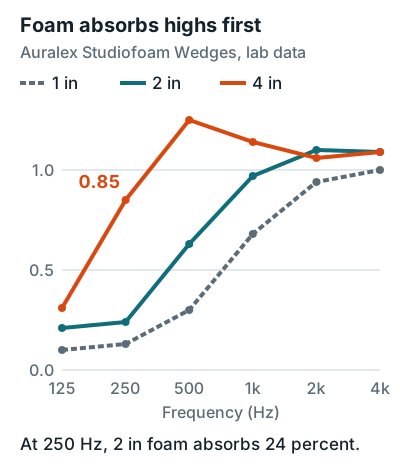
The numbers come from Riverbank Acoustical Laboratories tests to ASTM C423 with the foam flat on the test surface: 1 inch, 2 inch, and 4 inch. Auralex lists NRC ratings of 0.50, 0.75, 0.90, and 1.10 for its 1, 2, 3, and 4 inch wedges.
What acoustic foam can't do
Foam can't block sound and, at 1 to 2 inches, can't control bass. Awkwardly, those are the two jobs people most often buy it for.
Soundproofing
No
Foam absorbs inside the room. Auralex sorts products into "absorb" and "block," and foam is an absorber. See do acoustic panels keep sound out.
Low mids
0.24
The 2 inch figure at 250 Hz, so thin foam leaves the low mids as they were.
If your problem is noise from neighbors or traffic, foam won't help. Start with how to soundproof a room instead. Auralex's home studio guide puts it plainly: absorb sound "to improve sound within a room," block sound "to stop sound transmission."
Acoustic foam vs panels
At the same 2 inch thickness, fiberglass panels absorb about three times as much as wedge foam at 250 Hz. That gap is why panels win in a mixing room, where the low mids are what make a mix muddy.
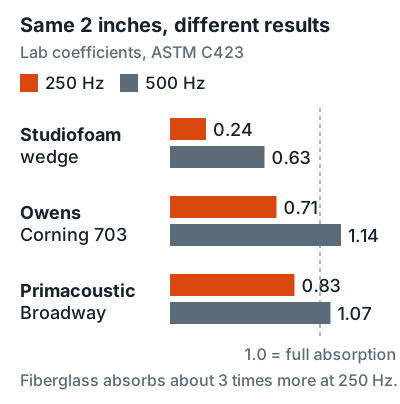
| 2 inch product | Core | 125 Hz | 250 Hz | 500 Hz | 1 kHz | NRC |
|---|---|---|---|---|---|---|
| Auralex Studiofoam Wedges | Foam | 0.21 | 0.24 | 0.63 | 0.97 | 0.75 |
| Owens Corning 703 | Fiberglass, 3 pcf | 0.15 | 0.71 | 1.14 | 1.16 | 1.00 |
| Primacoustic Broadway | Glass fiber, 6 pcf | 0.45 | 0.83 | 1.07 | 1.00 | 1.00 |
Choose foam when
The problem is flutter echo or bright reflections, you need something light that sticks on with adhesive, or you're treating a small spot in a voice-only room.
Choose panels when
You mix on monitors, you need control below 500 Hz, or your building code asks for a Class A flame spread rating.
For ready-made panels, see the best acoustic panels for a home studio. To build your own for less, see how to make acoustic panels. The full treatment plan lives in the home studio acoustic treatment guide.
Is acoustic foam a fire risk?
Untreated polyurethane foam ignites fast, so only buy foam with a stated flammability rating. This isn't theoretical. In the 2003 Station nightclub fire, pyrotechnics ignited polyurethane foam lining the stage walls and ceiling, and 100 people died. NIST's investigation found a non-fire-retarded sample "ignited within 10 seconds," while a fire-retarded sample did not ignite under similar conditions.
Acoustic foam in a vocal booth
Foam in a vocal booth removes the hard, fast reflections a mic picks up off close walls, but thin foam leaves the low mids alone. Line a closet with 1 inch foam (0.13 at 250 Hz, 0.68 at 1 kHz) and you take out the highs while 250 Hz stays almost untouched. That's the classic boxy, muffled closet vocal.
- Use 2 inches or more. Auralex's 4 inch wedges absorb 0.85 at 250 Hz, against 0.24 for 2 inch.
- Cover the walls nearest the mic first, since in a small booth their reflections arrive soonest.
- Put thicker absorption in the booth's corners if you have room, since GIK notes low frequencies build up in corners.
For booth builds and products, see vocal booth, how to build a vocal booth, and the best portable vocal booths.
How to use acoustic foam well
Put foam where reflections reach your ears or mic, in the thickest version you can fit. Placement follows the same rules as any panel, so a checkerboard across the whole wall isn't the goal.
- Find the first reflection points on the side walls and ceiling with the mirror method in where to place acoustic panels.
- Pick 2 or 4 inch foam, not 1 inch, unless the only problem is flutter echo between bare parallel walls.
- Mount it with the adhesive the maker specifies. Auralex lists Foamtak, Tubetak Pro, and EZ-Stick Pro Tabs for Studiofoam.
- Add bass traps in the corners, since foam leaves the bass as it was.
Auralex says its 4 inch wedges "can lessen the need for significant, dedicated bass trapping," but at 125 Hz they absorb 0.31, against 0.56 for 4 inch fiberglass board.
FAQ
Does acoustic foam soundproof a room?
No. Foam absorbs sound inside the room. It doesn't stop sound passing through walls, which takes soundproofing construction.
Is 1 inch acoustic foam worth buying?
Only for flutter echo and harsh highs. Auralex's 1 inch wedges absorb 0.13 at 250 Hz and 0.30 at 500 Hz, so they leave the low mids alone.
Is acoustic foam a fire hazard?
Untreated polyurethane foam can be. In NIST tests a non-fire-retarded foam sample ignited within 10 seconds, so buy foam with a stated flammability rating and check your local code.
Can 4 inch foam replace bass traps?
Partly. Auralex says its 4 inch wedges can lessen the need for dedicated bass trapping, but they absorb 0.31 at 125 Hz, against 0.56 for 4 inch Owens Corning 703.
Should I line a vocal booth with foam?
Use 2 inch foam or thicker, or fiberglass panels if you can. Thin foam soaks up the highs but leaves the low mids, so the booth loses its highs and keeps its low mid reflections.