What Are Studio Monitors?
Studio monitors are speakers built to play sound back flat, so you hear a recording as it is, without extra bass and treble. The Genelec 8030C, a common nearfield, is specified at 54 Hz to 20 kHz within plus or minus 2 dB.
How a studio monitor differs from a regular speaker
Monitor makers publish how far the response strays from flat, and the goal is a narrow window. Plenty of consumer speakers are voiced with extra bass and treble. That sounds big on the couch and hides problems in a mix.
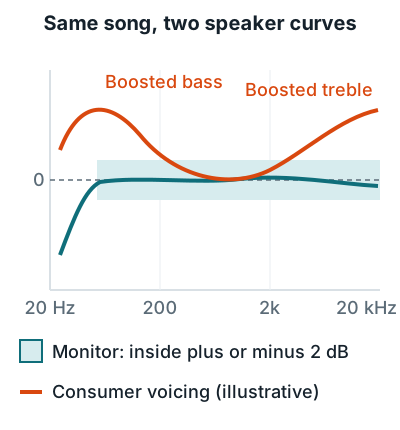
On its HS series page, Yamaha says the HS monitors aim for "the most honest, precise reference possible," unlike monitors with added bass or treble that "may sound more flattering at first." Flattering is the trap.
What's inside
Most studio monitors are active, so each driver gets its own built-in amp. The Yamaha HS5 runs a 45 W woofer amp and a 25 W tweeter amp, and the 8030C uses two 50 W amps. More in active vs passive studio monitors.
Flat response
±2 dB
Genelec 8030C window, 54 Hz to 20 kHz.
Built-in amps
2
One per driver on most two-way models.
Room switches
0 to minus 4 dB
Yamaha HS bass cut below 500 Hz.
The bass cut switch offsets the extra low end you get near a wall, per the Yamaha HS manual. To choose a pair, see the best studio monitors for home studios.
Related questions
What is a studio monitor speaker?
It's a speaker built for recording and mixing, tuned to play sound back without boosted bass or treble. Most are powered, with the amps and crossover inside the cabinet.
Are studio monitors the same as computer monitors?
No. A studio monitor is a speaker. Here, monitor means listening to check your work, not a screen.
Why do studio monitors sound less exciting than hi-fi speakers?
They skip the extra bass and treble many consumer speakers add. Yamaha notes that monitors with added bass or treble may sound more flattering at first, which is why they mislead you in a mix.
More answers: Home recording FAQ