Home Studio Acoustic Treatment Guide
Acoustic treatment is absorption placed inside a room to cut reflections and bass buildup. In a home studio it goes in three steps: bass traps in the corners, panels at the first reflection points, then a ceiling cloud above your seat. Measure the room before and after with free REW software so you can see what each step actually changed.
Almost everyone's first treatment buy is a box of foam squares, and almost everyone regrets it. This page is the order that works instead.
What acoustic treatment does and doesn't do
Acoustic room treatment changes how a room sounds to your mic and your ears. It doesn't stop sound leaving the room, so don't buy it for that. Auralex's home studio guide splits products into "Absorb Sound to improve sound within a room" and "Block Sound to stop sound transmission," and only the second is soundproofing.
So panels won't keep your roommate's TV out of a bedroom (more in do acoustic panels keep sound out), and they aren't thermal insulation either (do acoustic panels help with insulation). Not sure your room needs treatment at all? Read do I really need acoustic treatment. For what lab and real-room evidence shows, see do acoustic panels work.
Measure the room before you treat it
A before and after measurement tells you which problems treatment fixed and which are still there, so you stop guessing. Room EQ Wizard (REW) is free for Windows, macOS, and Linux, and its developer recommends a calibrated USB mic such as miniDSP's UMIK-1.
- Set up the mic on a stand where your head sits in the mix position.
- Run a sweep in REW through your monitors and save the measurement before you hang anything.
- Read the low end in decay plots. REW's RT60 help page says RT60 "is typically not meaningful" below a few hundred Hz in domestic rooms, so use the waterfall, spectrogram, and decay plots down there.
- Treat one step at a time and measure again after each, from the same mic position. Change two things at once and you won't know which one helped.
Treatment order: corners, reflections, ceiling
Go in this order, because each step fixes a bigger problem than the one after it. Auralex's home studio guide says "the first step for acoustic treatment in any small room should be to place Bass Traps in all of the corners," and its home studio treatment article moves on to the first reflection points, the wall behind the monitors, and the ceiling over the mix position.
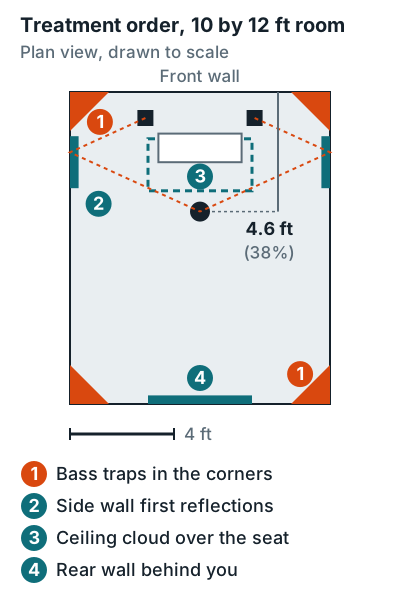
- Bass traps in the corners. Start with the vertical floor to ceiling corners. Thickness and placement are on bass traps.
- Side wall first reflections. Sit in the mix seat while a helper slides a mirror along the wall. GIK says "wherever you can see the loudspeaker in the mirror is a first reflection point." More in where to place acoustic panels.
- Ceiling cloud. Hang a panel flat on or below the ceiling directly above the mix position, an area Auralex says is "often overlooked."
- Front and rear walls. Auralex puts absorption behind the monitors and behind you to tame the slap-back echo bouncing between those two walls. See acoustic panels behind speakers.
Set your seat before you hang anything, since every reflection point moves when you do. Auralex puts the chair at 38 percent of the room's longest dimension, which is why the plan above has you 4.6 feet from the front wall. The reasoning is on the 38 percent rule page. For hardware, see how to hang acoustic panels, and for spacing a panel off the wall, see how far off the wall acoustic panels should be.
How much treatment you need
Panel count depends on room size and what the room is for, so work it out for your room instead of copying someone else's photo. How many acoustic panels do I need has the method, or you can plug your room's dimensions into the acoustic panel calculator.
For bass, more really is better: GIK's bass trap guide says total coverage area relative to room size is "the biggest determinant" of how well bass traps work. Mids and highs are a different story. You don't need wall-to-wall panels for those (see do I need to cover the entire wall with acoustic panels).
Which materials work
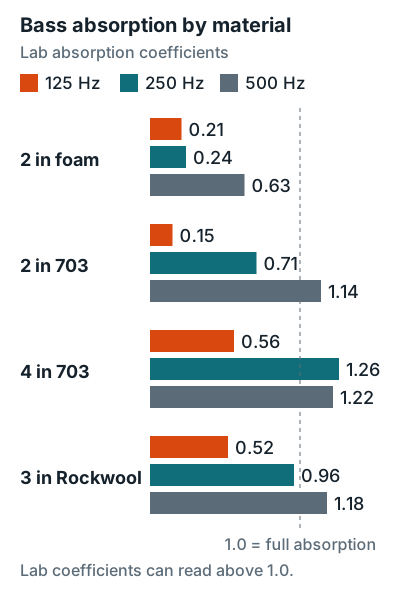
Dense fiberglass or mineral wool at least 2 inches thick beats foam of the same thickness below 500 Hz. The chart compares lab absorption coefficients from each manufacturer's published data (1.0 means the material absorbs all the sound that hits it).
| Material | Thickness | 125 Hz | 250 Hz | 500 Hz | NRC |
|---|---|---|---|---|---|
| Auralex Studiofoam Wedges | 2 in | 0.21 | 0.24 | 0.63 | 0.75 |
| Owens Corning 703 | 2 in | 0.15 | 0.71 | 1.14 | 1.00 |
| Owens Corning 703 | 4 in | 0.56 | 1.26 | 1.22 | 1.15 |
| Rockwool Safe'n'Sound | 3 in | 0.52 | 0.96 | 1.18 | 1.05 |
| Primacoustic Broadway | 2 in | 0.45 | 0.83 | 1.07 | 1.00 |
Foam's limits get their own page in acoustic foam, core materials are in what acoustic panels are made of, and thickness is in how thick acoustic panels should be. If you'd rather buy than build, ready-made options are compared in the best acoustic panels for a home studio, with price bands in how much acoustic panels cost.
DIY acoustic treatment
A DIY panel is a wooden frame, a slab of fiberglass or mineral wool, and breathable fabric. Bought panels use the same kind of core: GIK's 242 panel is built with Knauf insulation and Primacoustic's Broadway with glass fiber. Owens Corning 703 is a 3 pcf board, and Rockwool lists Safe'n'Sound as non-combustible with a flame spread index of 0.
Build
How to make acoustic panels: frame, core, and fabric step by step.
Cut
How to cut acoustic panels: tools for fiberglass, mineral wool, and foam.
Cover
What fabric to use: it has to let air through.
Finish
Can you paint acoustic panels: what paint does to absorption.
Panels have real downsides, DIY or bought. The honest list is in the disadvantages of acoustic panels.
Small room acoustic treatment
Small rooms need bass trapping most, because low frequencies pile up in their corners and make everything sound muddy. Auralex calls that buildup "one of the most common problems in small rooms," which "makes proper Bass Trapping very important in smaller spaces," and says treatment "should start approximately 30-36" off the floor" for a seated listener.
Bedrooms
Layout, desk position and what to treat first in bedroom studio setup.
Layout first
Face the short wall before buying panels: home studio design and layout.
Doors
Using the back of a door for a panel: can you put acoustic panels on a door.
Vocals
If you only record voice, compare a vocal booth with treating the whole room.
Every acoustic treatment guide
Here's every page in this section, grouped by the question it answers. For the bigger picture on gear, budget, and room, start with the home recording studio guide.
Products
Best acoustic panels, acoustic foam, bass traps, panel costs.
Planning
How many panels, panel calculator, wall coverage, thickness.
Placement
Where to place panels, the 38 percent rule, behind speakers, air gap, on a door.
Not treatment
FAQ
Does acoustic treatment soundproof a room?
No. Treatment absorbs sound inside the room to change how it sounds. Stopping sound getting in or out is soundproofing, a separate job done in the walls, doors, and windows.
What should I treat first in a home studio?
Bass traps in the corners, which Auralex calls the first step in any small room. Then panels at the side wall first reflection points, then the ceiling above your seat.
Is acoustic foam good enough for room treatment?
Only for highs and flutter echo. In lab tests 2 inch Auralex foam absorbs 0.24 at 250 Hz, against 0.71 for 2 inch Owens Corning 703 fiberglass.
Is DIY acoustic treatment as good as bought panels?
It can be, because bought panels use insulation cores too. A 3 inch Rockwool Safe'n'Sound batt absorbs 0.52 at 125 Hz and 0.96 at 250 Hz in Rockwool's published data.
How do I know if acoustic treatment worked?
Measure at your listening position before and after with free REW software and a calibrated USB mic. Compare the frequency response and the low frequency decay plots, not the RT60 figure alone.