How to Set Up a Podcast Studio at Home
To set up a podcast studio at home, give each host a dynamic mic 1 to 6 inches from their mouth, record each mic to its own track, put everyone in closed-back headphones, and use the smallest, softest room you have. One host can do this with a single USB mic for about $400 to $750; two hosts need two XLR mics and a 2-input interface or podcast mixer, for about $800 to $1,700.
The good news for spoken word: you need less gear than musicians do, and the room deserves more of your attention. A bad-sounding podcast is often an echoey room and a mic that's too far away, not a cheap mic.
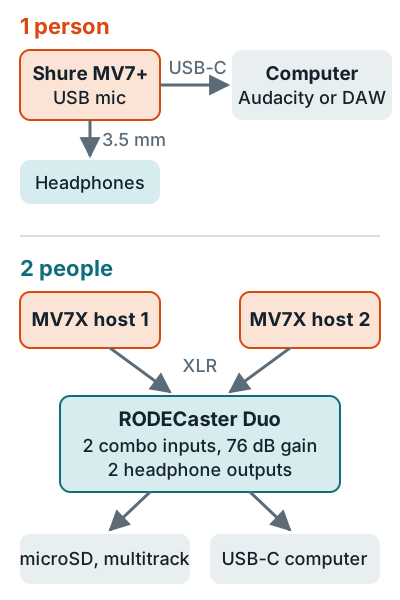
1-person podcast setup
A solo host needs one USB dynamic mic, a boom arm, and closed-back headphones. That's it. The Shure MV7+ is a cardioid dynamic with USB-C, an XLR output for later, and a 3.5 mm jack for latency-free monitoring.
| Item | Pick | Why | Price band |
|---|---|---|---|
| Mic | Shure MV7+ | USB-C and XLR, records 24-bit, 48 kHz | $200 to $400 |
| Boom arm | RØDE PSA1+ | Holds mics from 94 g to 1.2 kg | $100 to $200 |
| Headphones | Any closed-back pair | Plugs into the mic's 3.5 mm jack | Under $150 |
| Software | Audacity | Free on Windows, Mac, and Linux | Free |
| Total | About $400 to $750 |
Audacity is free, open source, and runs third-party VST3 plugins. The RØDE PSA1+ comes with a desk clamp and a threaded desk mount. Headphone picks are on best closed-back studio headphones, and more mics are on best microphone for voice and podcast recording.
2-person podcast setup
Two hosts need two XLR mics and a box with two mic inputs and two headphone outputs. That way each voice lands on its own track, and both of you can hear the conversation. The Shure MV7X is Shure's XLR podcast mic, a dynamic "optimized for spoken word" with "excellent rear rejection." That rear rejection is exactly what you want with another talker across the table.
Interface route
2i2 + splitter
The Scarlett 2i2 4th Gen has 2 mic preamps with 69 dB of gain but only 1 headphone output, so add a headphone amp or splitter.
Podcast mixer route
RODECaster Duo
2 combo inputs, 0 to 76 dB gain, 2 headphone outputs, and multitrack recording to microSD, USB storage, or a computer, per RØDE's datasheet.
| Item | Interface route | Podcast mixer route |
|---|---|---|
| 2 mics | 2 x Shure MV7X, $300 to $400 | 2 x Shure MV7X, $300 to $400 |
| Recorder | Scarlett 2i2 4th Gen, $200 to $250 | RODECaster Duo, $400 to $600 |
| 2 boom arms | 2 x RØDE PSA1+, $200 to $400 | 2 x RØDE PSA1+, $200 to $400 |
| 2 headphones | $100 to $300 total, plus a headphone amp | $100 to $300 total |
| Total | About $800 to $1,400 | About $1,000 to $1,700 |
Both routes can also drive a Shure SM7B, the famously gain-hungry broadcast dynamic. Its user guide asks for more than 60 dB of preamp gain, and the 2i2 has 69 dB and the Duo 76 dB. Other interfaces are compared on best audio interface for home recording.
Mic layout for two hosts
Sit the hosts facing each other. Each mic goes 1 to 6 inches from its own host, with its back pointed at the other one. Shure gives 1 to 6 inches as the SM7B's working distance and says speaking close blocks off-axis noise, which here means the other host's voice.
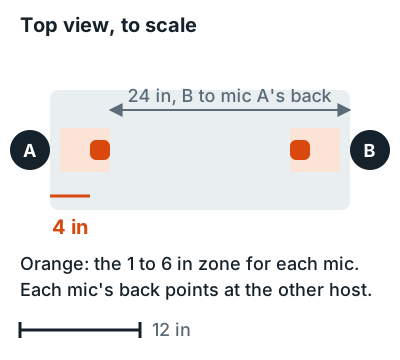
The spacing follows the same logic as the 3 to 1 rule for microphones. Put each mic on its own arm so the hosts can lean in without bumping the table. Stand options are on best mic stands.
Choose and treat the room
Use the smallest room with the most soft stuff in it, and switch off anything with a fan. Neumann's home studio guide says "an open wardrobe filled with clothes can serve as a large absorber" and warns that the mic can pick up fan noise.
- Pick a carpeted room with soft furniture, away from the street side of the house.
- Put each host's back to the softest wall, such as an open closet, so the front of the mic faces it.
- Turn off HVAC and fans while recording. If your mic has a bass rolloff switch, use it. Shure says the SM7B's lowers hum from A/C, HVAC, and traffic.
- Add panels at the first reflection points if the room still sounds hollow or boxy. Placement is in home studio acoustic treatment.
Recording settings and loudness
Record each host to a separate mono track at 24-bit and 48 kHz. Then mix to Apple's loudness target before you upload.
That target comes from Apple's podcast audio requirements, which also list 44.1 or 48 kHz at 24-bit as recommended for WAV and FLAC, and prefer AAC over MP3 for RSS feeds. When you set your record level, leave plenty of headroom so peaks stay well below clipping. The steps are in gain staging.
Podcast studio ideas for small spaces
Most home podcast studios land on one of three layouts. Which one depends on how many people talk and how much space you've got.
Closet corner
Solo
Stand with your back to the hanging clothes so the cardioid mic faces them. Neumann rates clothes behind the speaker above clothes behind the mic. Works for voice over too.
Desk and arm
Solo
A boom arm clamped to your desk keeps the mic at mouth height and off the desk, away from keyboard clatter.
Face-to-face table
2 hosts
Two arms, mics back to back, hosts 2 feet or more apart as in the layout above.
Want something permanent? A small booth is another option. See vocal booths for builds and costs.
Voice over and audiobooks
Voice over needs a quieter room than a podcast, because casting sites and audiobook platforms check the noise floor (the hiss and hum under your voice). The targets and the room build are on home voice over studio setup.
FAQ
What equipment do I need for a podcast studio?
One dynamic mic per host, a way to record each mic on its own track, closed-back headphones for everyone, and a boom arm or stand. A solo host can do it with one USB mic like the Shure MV7+.
How much does a home podcast studio cost?
About $400 to $750 for one host with a USB mic, boom arm, and headphones, and about $800 to $1,700 for two hosts, depending on whether you use an interface or a podcast mixer. Prices change, so check current listings.
Can two people share one USB mic for a podcast?
Not well. Each host should have a mic 1 to 6 inches from their mouth, which is Shure's working distance for the SM7B, and their own track for editing.
What loudness should a podcast be?
Apple Podcasts asks for about minus 16 dB LKFS, plus or minus 1 dB, with true peaks no higher than minus 1 dBFS, measured to ITU-R BS.1770-5.
Do I need acoustic treatment for a podcast?
A small room with soft furnishings and a dynamic mic worked close gets most home podcasts clean. Neumann notes an open closet full of clothes works as a large absorber.
More answers: Home recording FAQ