Best Microphone for Recording Vocals
The best microphone for recording vocals at home is the Shure SM7B if your room is untreated, because a close-worked dynamic hears far less of the walls. In a quiet, treated room, the RØDE NT1 5th Gen gives you condenser detail with just 4 dBA of self-noise for a few hundred dollars.
Shop in this order: room, then voice, then budget. The other five picks below cover a missing interface, loud singers, tight budgets, and a mic to keep for decades.
Quick picks
These are seven current mics, and every spec comes from the maker's own page or spec sheet.
| Pick | Type | Best for | Key spec | Price band |
|---|---|---|---|---|
| Shure SM7B | Dynamic, XLR | Untreated rooms, best overall | Needs 60+ dB of gain | $400 to $700 |
| RØDE NT1 5th Gen | Condenser, XLR and USB-C | Treated rooms, soft voices | 4 dBA self-noise | $200 to $400 |
| AKG C214 | Condenser, XLR | Loud singers, treated rooms | 156 dB SPL with pad | $400 to $500 |
| Neumann TLM 103 | Condenser, XLR | A long-term studio mic | 7 dB-A self-noise | Over $1,000 |
| Shure MV7+ | Dynamic, USB-C and XLR | No interface yet | 0 to 36 dB gain built in | $200 to $400 |
| Shure SM58 | Dynamic, XLR | Budget, bare rooms | Built-in pop filter | $100 to $200 |
| Audio-Technica AT2020 | Condenser, XLR | Budget, quiet rooms | 144 dB max SPL | $100 to $200 |
Pick by room and voice
Let your room decide dynamic or condenser, then let your voice pick the model. Shure's vocal recording guide says condensers "will capture room reflections," and that many engineers prefer dynamics for rock, metal, and rap, where a condenser's extra detail can work against the take.
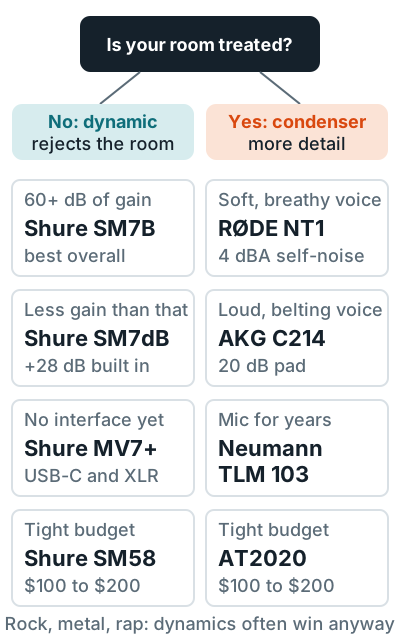
If you've got bare walls and a hard floor, your room is untreated, and the acoustic treatment guide shows what to fix first. The full tradeoff between the two types is on condenser vs dynamic microphone.
Shure SM7B: best overall
The Shure SM7B is the best vocal mic for a bedroom with bare walls. It's a cardioid dynamic that Shure says reduces distortion from loud sources, and it has switches for bass rolloff and presence boost.
| Spec | SM7B |
|---|---|
| Type, pattern | Dynamic, cardioid |
| Frequency response | 50 Hz to 20 kHz |
| Sensitivity | minus 59 dBV/Pa (1.12 mV) |
| Working distance | 1 to 6 inches |
| Weight | 0.764 kg (1.69 lb) |
Specs and distance are from the SM7B user guide, which says to speak 1 to 6 inches away "to block off-axis noise."
The catch: it's a quiet mic, and it's hungry for gain. Shure says to add an inline booster if your preamp has less than 60 dB of gain, and a common Scarlett Solo has 57 dB. More on that in do I need a preamp to record vocals.
RØDE NT1 5th Gen: best condenser value
The RØDE NT1 5th Gen is the best-value condenser for a treated room and the quietest mic here. It has both XLR and USB-C outputs, and the shock mount and pop filter come in the box.
| Spec | NT1 5th Gen |
|---|---|
| Capsule, pattern | 1 inch, cardioid condenser |
| Frequency range | 20 Hz to 20 kHz |
| Self-noise | 4 dBA |
| Max SPL | 142 dB SPL |
| Sensitivity | minus 32 dB re 1 V/Pa (25 mV) |
| USB recording | 24-bit or 32-bit float, 48 to 192 kHz |
Specs are from the NT1 5th Gen datasheet. RØDE says its 32-bit float USB mode lets you adjust level after recording with no risk of clipping.
The catch: at 25 mV/Pa it's sensitive, so in an untreated room it records your walls right along with your voice. Over XLR it needs 48 V phantom power.
AKG C214: best for loud singers
The AKG C214 is for belters and powerful voices in a treated room. Its 20 dB pad lets it take up to 156 dB SPL, per AKG, and a switchable bass cut at 160 Hz tames the boom you get from singing close.
| Spec | C214 |
|---|---|
| Pattern | Cardioid condenser |
| Frequency range | 20 Hz to 20 kHz |
| Sensitivity | 20 mV/Pa |
| Self-noise | 13 dB-A |
| Max SPL | 156 dB SPL with 20 dB pad |
| Power | Phantom, 9 to 52 V |
Its weak spot is noise: 13 dB-A of self-noise, 9 dB above the NT1's 4 dBA. For whispery vocals, the NT1 is the cleaner choice.
Neumann TLM 103: the step up
The Neumann TLM 103 is the mic to buy once your room is treated and you want one you won't outgrow. Neumann uses it in its own home studio vocal guide for "its direct sound, definition and ultra-low noise."
| Spec | TLM 103 |
|---|---|
| Pattern | Cardioid condenser |
| Frequency range | 20 Hz to 20 kHz |
| Sensitivity | 23 mV/Pa |
| Self-noise | 7 dB-A |
| Max SPL | 138 dB (0.5% THD) |
| Power | 48 V phantom, 3 mA |
Just know it costs over $1,000 and only pays off in a treated room. If yours isn't treated yet, spend part of that budget on treatment first.
Shure MV7+: best without an interface
The Shure MV7+ is the pick if you don't own an interface yet. It's a cardioid dynamic with USB-C and XLR outputs, a headphone jack, and onboard DSP that includes a denoiser, compressor, limiter, and high-pass filter.
| Spec | MV7+ |
|---|---|
| Type, pattern | Dynamic, cardioid |
| Frequency response | 50 Hz to 16 kHz |
| Built-in gain | 0 to 36 dB |
| USB format | 24-bit, 48 kHz |
| XLR sensitivity | minus 55 dBV/Pa (1.78 mV) |
Over USB, you're stuck at 48 kHz on Shure's own preamp. The XLR output is your way out later. The wider tradeoffs are on are USB mics good for recording vocals and XLR vs USB microphone.
Budget picks: SM58 and AT2020
Both sit in the $100 to $200 band, and they split by room the way the pricier picks do.
Bare room: Shure SM58
50 Hz to 15 kHz
Dynamic with a built-in pop filter and shock mount, per the SM58 user guide. Less top-end air, and like the SM7B it needs plenty of gain.
Quiet room: AT2020
20 dB SPL noise
Cardioid condenser, 144 dB max SPL, needs 48 V phantom, per Audio-Technica. No pad or low-cut switch, and the noisiest condenser here.
More options under $200 are on the best budget microphone for vocals page.
How to choose a vocal mic
Four lines on the spec sheet decide almost every vocal mic: type, sensitivity, self-noise, and max SPL. Match each one to your room, your interface, or your voice.
- Match type to your room. Untreated means dynamic; treated means condenser is an option.
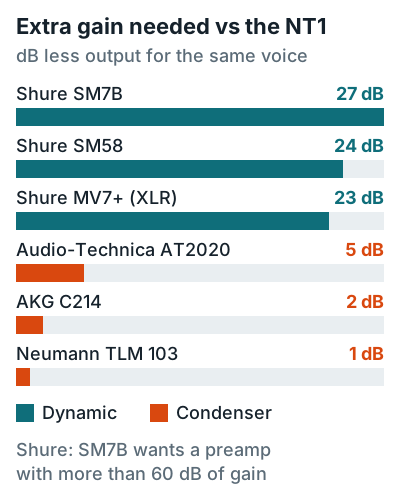
- Match sensitivity to your interface. The SM7B gives 27 dB less signal than the NT1 for the same voice, so check your preamp's gain figure before buying a dynamic.
- Match self-noise to soft singing. Lower is quieter: NT1 4 dBA, TLM 103 7 dB-A, C214 13 dB-A, AT2020 20 dB SPL.
- Match max SPL to loud singing. Every condenser here handles 138 dB SPL or more, and a pad like the C214's raises the ceiling further.
- Check power. Condensers and the SM7dB need 48 V. See what phantom power is.
Once the mic arrives, placement, gain, and getting a keeper take are on how to record vocals at home. Every other source is covered in the microphones for home recording hub.
FAQ
What is the best microphone for recording vocals?
The Shure SM7B if your room is untreated, the RØDE NT1 5th Gen if it's treated. With over $1,000 and a treated room, the Neumann TLM 103 is the step up.
What is the best mic to record vocals at home on a budget?
The Shure SM58 for a bare room or the Audio-Technica AT2020 for a quiet, treated one, both in the $100 to $200 band.
Do I need phantom power for a vocal mic?
Condensers like the NT1, AT2020, C214, and TLM 103 need 48 V phantom power from the interface. The SM7B and SM58 don't, but the SM7dB needs it to run its built-in preamp.
Can I record singing with a USB mic?
Yes. The Shure MV7+ records 24-bit, 48 kHz over USB-C and also has an XLR output, so it still works if you add an interface later.
How far should I sing from the mic?
About 8 to 12 inches from a condenser, per Neumann's home vocal guide, and 1 to 6 inches from an SM7B, per Shure.