Best Microphone for Voice and Podcast Recording
The best USB microphone for podcast recording is the Shure MV7+: a cardioid dynamic that hears your voice more than your room, with USB-C and XLR outputs so it keeps working when you add an interface. With an interface that has 60 dB or more of gain, the Shure SM7B is the XLR step up.
Pick a dynamic if your room is untreated, and most spare rooms and home offices are. Pick a condenser only if the room is treated or you record in a closet booth.
Quick picks
Here are six current mics, three for USB and three for XLR. Specs come from each maker's own page or spec sheet.
| Pick | Connection | Type | Best for | Price band |
|---|---|---|---|---|
| Shure MV7+ | USB-C and XLR | Dynamic | Best overall, untreated rooms | $200 to $400 |
| RØDE PodMic USB | USB-C and XLR | Dynamic | RØDE software users, desk setups | $150 to $250 |
| RØDE NT-USB+ | USB-C | Condenser | Treated rooms, closet booths | $150 to $200 |
| Shure SM7B | XLR | Dynamic | Best XLR, interfaces with 60+ dB gain | $400 to $700 |
| Shure MV7X | XLR | Dynamic | Budget XLR, second host | $150 to $200 |
| Electro-Voice RE20 | XLR | Dynamic | Broadcast sound, hosts who move | $400 to $600 |
Dynamic vs condenser for untreated rooms
In an untreated room, a dynamic mic is the better choice for voice. You work it 1 to 6 inches away, so your voice drowns out the reflections. Shure's recording guide says condensers "will capture room reflections," and those reflections are "unlikely to improve the recording" outside a designed space.
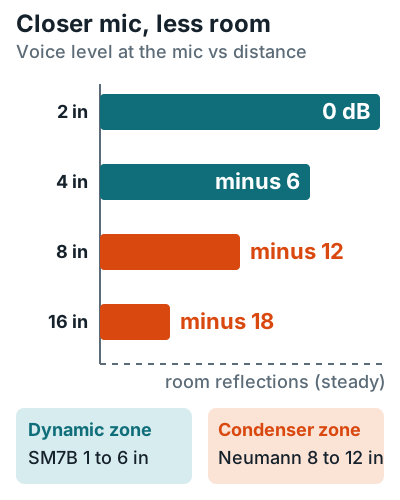
Those numbers come from the inverse square law. The OSHA Technical Manual's noise chapter notes that sound pressure level drops 6 dB each time the distance from a point source doubles. The SM7B guide says to speak 1 to 6 inches away, while Neumann's home studio guide sets a condenser 8 to 12 inches back. The full type comparison is on condenser vs dynamic microphone.
USB vs XLR picks
USB suits one host recording straight into a computer. XLR suits two or more hosts, because each mic takes one interface input. A hybrid mic with both outputs lets you start on USB and switch later without buying another mic. Two of the three USB picks here are hybrids.
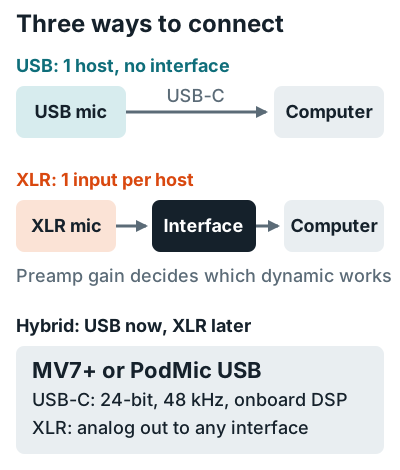
Two USB mics can work together. Apple's Aggregate Device guide uses several USB mics as its example, but you have to set it up in Audio MIDI Setup before your apps see them as one device. The wider tradeoffs are on XLR vs USB microphone and are USB mics good for recording vocals.
Shure MV7+: best overall
The Shure MV7+ is the best USB microphone for voice recording in an ordinary room. Its onboard DSP includes Auto-Level Mode, a real-time denoiser, a compressor, a limiter, and a high-pass filter, so a solo host can record finished-sounding audio with no interface at all.
| Spec | MV7+ |
|---|---|
| Type, pattern | Dynamic, cardioid |
| Frequency response | 50 Hz to 16 kHz |
| USB format | 24-bit, 48 kHz |
| Built-in gain | 0 to 36 dB |
| Outputs | USB-C, passive XLR, 3.5 mm headphone |
The catch: on a computer, USB recording is fixed at 24-bit, 48 kHz. Shure lists 16-bit, 44.1 kHz for iOS only. If you also sing, it doubles as the no-interface pick for singers.
RØDE PodMic USB: best for RØDE setups
The RØDE PodMic USB is the other hybrid dynamic here, with APHEX processing (compressor, noise gate, high-pass filter, Aural Exciter, and Big Bottom) built in. Its datasheet lists a cardioid dynamic capsule, 20 Hz to 20 kHz, 24-bit, 48 kHz USB, and a 3.5 mm headphone jack.
The catch: it weighs about 2 lb (900 g), so it needs a sturdy boom arm. See best mic stand.
RØDE NT-USB+: best for treated rooms
The RØDE NT-USB+ is the USB condenser for a treated room or a closet booth, where its extra detail helps instead of exposing the walls. RØDE lists a tight cardioid condenser capsule, its Revolution Preamp, APHEX processing, and zero-latency headphone monitoring.
Keep in mind it's USB only, and in an untreated room it records far more echo than any dynamic here. For a small booth, see vocal booth.
Shure SM7B: best XLR mic
The Shure SM7B is the best XLR microphone for podcast recording if your interface can drive it. Shure markets it for "professional podcasters, streamers, and vocalists." Its rear switches add a bass rolloff for HVAC or traffic hum and a presence boost for clarity.
| Spec | SM7B |
|---|---|
| Type, pattern | Dynamic, cardioid |
| Frequency response | 50 Hz to 20 kHz |
| Sensitivity | minus 59 dBV/Pa (1.12 mV) |
| Working distance | 1 to 6 inches |
XLR on a budget or for broadcast: MV7X and RE20
These two sit at opposite ends of the XLR range: the MV7X for a cheap second host, and the RE20 for a radio-style sound. Neither needs phantom power.
Budget: Shure MV7X
minus 55 dBV/Pa
Passive XLR dynamic, 50 Hz to 16 kHz, per the MV7X guide. 4 dB hotter than the SM7B, so it's easier on small preamps.
Broadcast: EV RE20
45 Hz to 18 kHz
Large diaphragm dynamic with Variable-D, which Electro-Voice says gives minimal proximity effect, per the RE20 page. Built for broadcast and podcast voice work.
How to choose a voice recording mic
Four questions settle it: your room, your host count, your interface, and your mic distance.
- Judge the room. Bare walls mean a dynamic (MV7+, PodMic USB, SM7B, MV7X, RE20). In a treated room or closet booth, the NT-USB+ is an option. The acoustic treatment guide covers the fix.
- Count hosts. One host can stay on USB. Two or more means XLR mics and an interface with one input each.
- Check preamp gain. The SM7B wants 60 dB or more. With less than that, pick the MV7X or a hybrid on USB, or add a booster.
- Set the distance. Stay 1 to 6 inches from a dynamic like the SM7B, per Shure, and keep it constant through the episode.
The voice-over workflow, levels, and a closet booth setup are on the best way to record a voice over at home. Mics for singing and instruments are in the microphones for home recording hub.
FAQ
What is the best USB microphone for podcast recording?
The Shure MV7+. It's a cardioid dynamic that rejects room sound, records 24-bit, 48 kHz over USB-C, and has an XLR output for when you add an interface.
Is a dynamic or condenser mic better for voice recording?
A dynamic, unless your room is treated. You speak 1 to 6 inches from a dynamic like the SM7B, so your voice is far louder than the room's reflections.
Can two people podcast with USB mics?
Yes, but on a Mac you first combine them into an Aggregate Device in Audio MIDI Setup. Two XLR mics into a two-input interface such as the Scarlett 2i2 4th Gen is simpler.
Do I need a cloudlifter for a podcast mic?
Only if your preamp is short on gain. Shure says to add an inline booster for the SM7B when the preamp has less than 60 dB, and the Scarlett Solo 4th Gen has 57 dB.
What is the best microphone for voice over at home?
The same picks apply: the MV7+ or SM7B in a normal room, a condenser like the NT-USB+ in a treated or closet booth. The full voice-over workflow is in our voice-over guide.