Bass Traps for Home Studios
Bass traps are thick absorbers, 4 inches deep or more, placed in a room's corners, where low frequencies build up. GIK Acoustics says a 2 inch panel rolls off around 300 Hz, a 4 inch trap reaches under 100 Hz, and a 6 inch trap does much better below 100 Hz. In short, thickness decides how low a trap works.
If your low end sounds great in one spot and vanishes a foot away, this is the page for you.
What a bass trap does
A bass trap soaks up the low frequencies that pile up where walls meet. GIK's bass trap guide explains that bass has more energy and travels further than treble, so its reflections combine in corners into peaks and nulls. That's why some bass notes boom and others disappear depending on where you sit.
Broadband (porous)
Start here
Thick fiberglass or mineral wool that absorbs bass, mids, and highs. GIK calls these the foundation.
Tuned (membrane)
Later
Aimed at one stubborn low resonance you found in a waterfall plot. GIK says they "should not be regarded as a foundational strategy."
Auralex's home studio guide calls low frequency buildup in corners "one of the most common problems in small rooms." Bass traps are step one, not the whole plan. The rest, panels and ceiling included, is in the home studio acoustic treatment guide.
Where to put bass traps
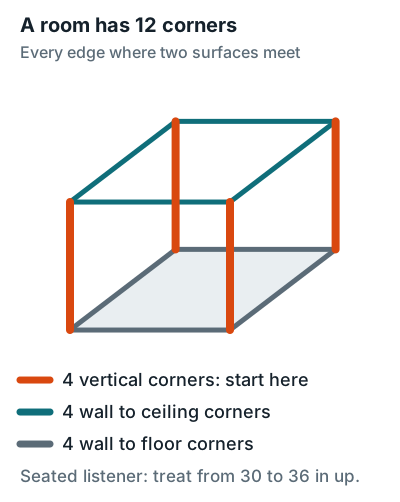
Put bass traps in the corners, starting with the four vertical floor to ceiling corners. Auralex says "the first step for acoustic treatment in any small room should be to place Bass Traps in all of the corners," and GIK adds that "there are eight more corners that can benefit from treatment" along the ceiling and floor.
- Find the worst corners. Play GIK's low-passed pink noise (content at 400 Hz and below), walk the room with an SPL meter, and treat the loudest spots first. Room EQ Wizard gives a more detailed picture.
- Trap the vertical corners. Floor to ceiling if you can. If not, Auralex says treatment should start "approximately 30-36" off the floor" for a seated listener.
- Add the wall to ceiling corners next. They're usually clear of furniture, which helps in a packed bedroom.
- Measure again from your mix seat and compare the low end with the first measurement.
A corner trap either fills the corner, like a triangular unit, or straddles it as a flat panel with air behind. Spacing a panel off a wall is covered in how far off the wall acoustic panels should be. Wall panels for reflections are a separate job, and that's on where to place acoustic panels.
Bass trap thickness vs frequency
The thicker the trap, the lower it absorbs. GIK puts it as "the thicker the panel the lower the effective range," and says that in rooms where bass matters most you should "make every panel in the room as thick as possible."
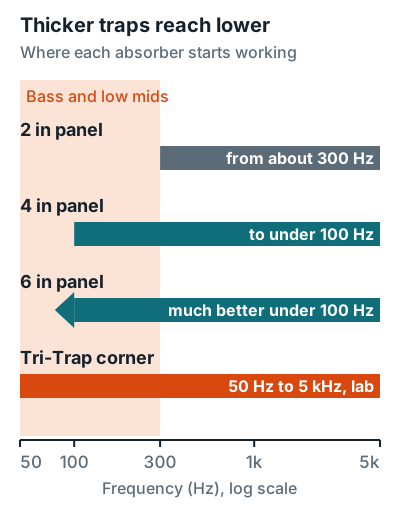
Lab coefficients at 125 Hz tell the same story:
| Absorber | Thickness | Absorption at 125 Hz |
|---|---|---|
| Owens Corning 703 | 1 in | 0.05 |
| Owens Corning 703 | 2 in | 0.15 |
| Owens Corning 703 | 3 in | 0.34 |
| Owens Corning 703 | 4 in | 0.56 |
| Rockwool Safe'n'Sound | 3 in | 0.52 |
| Auralex Studiofoam Wedges | 4 in | 0.31 |
For panel thickness at reflection points, as opposed to corners, see how thick acoustic panels should be. Why foam falls short down low is explained in acoustic foam.
DIY vs bought bass traps
DIY traps can be as thick as your corners allow. Bought traps come with lab test data for the finished product and a fire rating. Inside, they're not that different: GIK builds with Knauf insulation and Primacoustic with 6 pcf glass wool.
| Option | Size | Core | Test data | Fire rating |
|---|---|---|---|---|
| DIY with 703 or Safe'n'Sound | You choose | 703: 3 pcf fiberglass; Safe'n'Sound: about 2.5 pcf mineral wool | Core only, flat mounted | Safe'n'Sound: non-combustible |
| GIK Tri-Trap | 47 in tall, 23.5 in face | Knauf insulation | Riverbank, 50 Hz to 5 kHz | Class A |
| Primacoustic MaxTrap | 24 x 48 x 19 in | 3 in, 6 pcf glass wool front | Riverbank corner test | Not stated |
| Auralex LENRD | 1 x 1 x 2 ft | Foam (Studiofoam line) | A-mount and corner (J-mount) reports | Not stated on product page |
Build your own if
You have time and tools, want traps thicker than 4 inches, or need many. Start with how to make acoustic panels and how to cut the core.
Buy if
You want tested performance, a stated fire rating, and freestanding units (handy if your landlord frowns on holes). Compare options in the best acoustic panels roundup.
GIK's Tri-Trap starts at $199 on GIK's site, and Auralex lists LENRD pairs from $113.99 at the time of writing. For DIY material and panel costs, see how much acoustic panels cost.
How many bass traps you need
Fit as many as your corners allow, because bass trapping improves with every trap added. GIK says "the more bass traps we add to a room, the better the bass response will be," and that total trap area relative to room size is "the biggest determinant."
For a count based on your actual room, use how many acoustic panels do I need or the acoustic panel calculator.
FAQ
Where should bass traps go?
In the corners, starting with the four vertical floor to ceiling corners. Then add traps along the wall to ceiling corners, which GIK lists among the eight other corners that build up bass.
How thick should a bass trap be?
At least 4 inches. GIK says 2 inch panels roll off around 300 Hz, 4 inch reach under 100 Hz, and 6 inch perform much better under 100 Hz.
Can I make my own bass traps?
Yes. Owens Corning 703 board absorbs 0.56 at 125 Hz at 4 inches thick, and 3 inch Rockwool Safe'n'Sound absorbs 0.52, the same kind of insulation core GIK and Primacoustic build with.
Do foam bass traps work?
Less well than fiberglass of the same depth flat on a wall: 4 inch Auralex wedge foam absorbs 0.31 at 125 Hz against 0.56 for 4 inch 703. Corner foam traps are deeper, so check the maker's corner test report.
How many bass traps do I need?
As many as you can fit, starting with the corners. GIK says total trap area relative to room size is the biggest factor in how well they work.