Bedroom Studio Setup
A bedroom music studio works when the desk sits centered on the short wall, your head sits about 38 percent of the room's length from it, and the bed stays behind you. Neumann's vocal recording guide says a bedroom or living room "is often good enough" to record in. So the work is layout and a few removable panels, not construction.
Where everything goes in a bedroom studio
Put the desk on the short wall, centered, with the room's length running behind you. In GIK Acoustics' test room, facing the short wall cut the spread between bass peaks and nulls from 30 dB to about 16 dB. All it costs is moving some furniture.
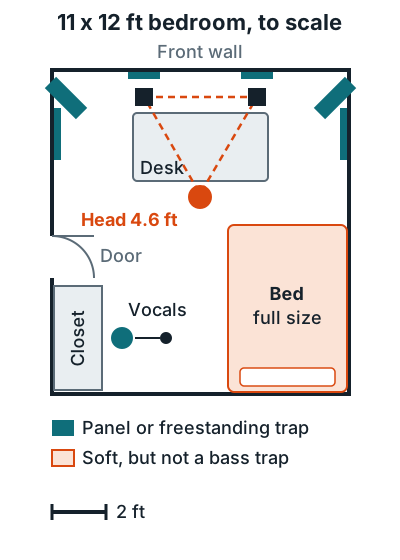
- Center the desk on the short wall. Both monitors then sit the same distance from their side walls.
- Find your chair position. Sit 38 percent of the room length from the front wall, which is 4.6 feet in a 12 foot room. The 38 percent rule page explains why.
- Push the bed to the rear. Headboard on the rear wall, in a corner, so it's behind your listening position and out of the monitor triangle.
- Keep monitors out of shelves. Yamaha's HS series manual asks for at least 8 inches (20 cm) of space at the sides, behind, and above, and warns against confined spots.
- Use the bass switch if monitors sit near a wall. The JBL 305P MkII, for example, has a boundary EQ that cuts 1.5 or 3 dB at 50 Hz to offset the boost from walls and desktops.
Monitor angles and tweeter height are in how to set up studio monitors, and the full layout logic for any room is in home studio design and layout.
Does the bed absorb bass?
Don't count on it. GIK says bass builds up most in room corners and needs absorbers about 4 inches thick or more to work below 100 Hz, while a 2 inch panel stops near 300 Hz. A bed sits on the floor, mostly away from the corners, so it can't do a corner trap's job.
Freestanding corner traps are the bedroom-friendly version. See bass traps for sizes.
Sharing the room: what changes
A bedroom studio shares hours and walls with sleep, so plan for quiet work. Each card below is one tradeoff and its fix.
Late nights
Closed-back
Track and mix quietly on closed-back headphones. Picks: best closed-back studio headphones.
Neighbors
Volume, not foam
Panels don't stop sound from leaving the room. See soundproofing a room in an apartment.
Hearing
85 dBA
NIOSH's limit over 8 hours. Every 3 dB louder halves the safe time.
Setup time
Leave it wired
Keep the mic on its stand and cables plugged in so a session starts in a minute.
The hearing limit is from NIOSH's noise guidance. Mixing only on headphones is workable, but check on monitors at a moderate level when the house is awake. Are studio monitors worth it covers that tradeoff.
Renter-friendly acoustic treatment
Use panels you can take with you: strip-mounted panels on smooth walls, or freestanding panels on floor stands. Both leave no holes, so your security deposit stays yours.
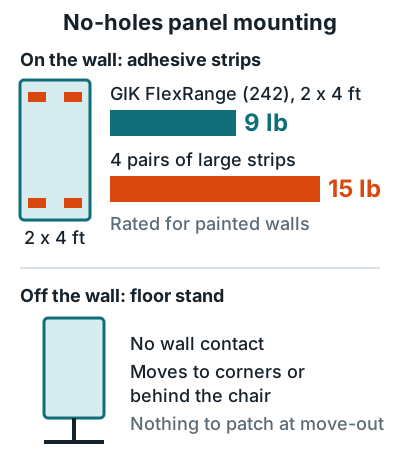
The weights are from the GIK 242 datasheet, which also lists freestanding metal stands as a mounting option. GIK now sells the panel as FlexRange. 3M's page for Command Large Picture Hanging Strips says 4 pairs hold 16 lb, lists 15 lb in its spec table, and names painted walls as a surface. Plan to the lower number.
- Stand traps in the front corners. These do the most for bass and need no wall contact.
- Strip-mount panels at the side wall reflection points. Use 4 pairs per 2 by 4 foot panel and stay under 15 lb.
- Add one panel behind each monitor. Neumann's room guide starts treatment there.
Placement details are in where to place acoustic panels, and the acoustic panel calculator sizes the order for your room.
Recording vocals in a bedroom
Record with your back to an open closet full of clothes, facing the mic. Neumann's room guide calls an open wardrobe a large absorber and places it behind the singer, so the cardioid mic faces the soft side and rejects the room behind it. A boxy bedroom vocal often comes from the room, not the mic, and this is the free fix.
Stand out of the corners and 8 to 12 inches (20 to 30 cm) from the mic, as Neumann's vocal guide recommends, and keep the computer away from the mic so its fan stays off the take. Step-by-step technique is in how to record vocals at home, and a closet conversion is covered in vocal booth.
More room-by-room options are in home studio ideas, a $300 gear list is in home studio on a budget, and the home recording studio guide covers the rest of the setup.
FAQ
Is a bedroom good enough for recording?
Yes, for most home recording. Neumann's vocal recording guide says a bedroom or living room is often good enough, while bathrooms are usually too ambient.
Where should the bed go in a bedroom studio?
In a rear corner with the headboard on the rear wall, behind your listening position, so the front half of the room stays free for the desk and monitors.
Can I hang acoustic panels in a rental without drilling?
Yes. A 2 by 4 foot GIK FlexRange (formerly 242) panel weighs 9 lb, under the 15 lb 3M lists for Command Large Picture Hanging Strips, and floor stands need no wall contact at all.
Should I mix on headphones or monitors in a bedroom?
Both. Use closed-back headphones when others are sleeping, and check mixes on monitors at a moderate level when you can. Each one shows problems the other hides.
How loud can I work on headphones?
Keep long sessions moderate. NIOSH's recommended limit is 85 dBA averaged over 8 hours, and each 3 dB increase halves the safe time.