How to Soundproof a Room
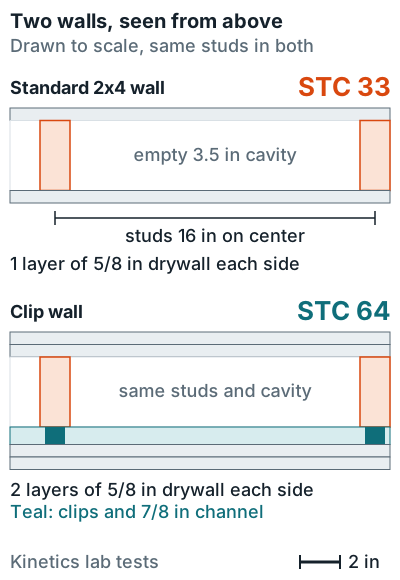
To soundproof a room, seal every air gap first, then upgrade the door and windows, and only then add mass and decoupling to the walls, floor, and ceiling. A standard 2x4 wall with one layer of drywall on each side and an empty cavity tests at STC 33. The same studs with two layers on each side, one side hung on isolation clips, test at STC 64 in Kinetics' lab results. Foam and acoustic panels won't do this job. They absorb echo inside the room and block almost nothing.
Soundproofing blocks, treatment absorbs
Soundproofing stops sound from passing through the room's shell. Acoustic treatment changes how sound behaves inside the room. Auralex's home studio guide draws the same line: "Absorb Sound to improve sound within a room or Block Sound to stop sound transmission."
Soundproofing (blocking)
Mass, seal, decouple
Drywall layers, airtight seals, isolation clips, and door and window upgrades. Keeps neighbors and traffic out and your music in.
Acoustic treatment (absorbing)
Panels, bass traps
Soft absorbers on the surfaces. They cut echo and boom in your recordings, but the sound still leaves the room. See home studio acoustic treatment.
Foam you already own is treatment, not soundproofing: it absorbs some echo and blocks almost nothing. Why panels don't stop noise is covered in do acoustic panels keep sound out. A recording room usually needs both, and the full studio plan is in how to soundproof a home studio.
What STC numbers mean
STC (Sound Transmission Class) is a single number for how much airborne sound a wall, door, or window blocks. Higher is better. National Gypsum notes the STC test covers 125 Hz to 4,000 Hz, and Andersen gives these plain-English meanings in its sound abatement guide:
| STC | Loud conversation on the other side |
|---|---|
| 30 | Heard and understood |
| 30 to 35 | Heard, but you can't follow it |
| 36 to 40 | Hardly audible |
How to soundproof a room, step by step
Work from the cheapest, biggest leak to the most expensive fix. A room is only as quiet as its weakest part. Owens Corning's assembly guide notes that "windows normally have lower transmission loss values than the surrounding wall," and the same goes for most doors.
- Find the leaks. Play music and listen from outside at the door edges, window frames, outlets, and vents.
- Seal every gap. Run acoustical sealant where the walls meet the floor and ceiling, and around outlet boxes and pipes.
- Fix the door. Hang a solid core door with full perimeter seals and a threshold or automatic door bottom.
- Fix the windows. Weatherstrip them, then add an interior insert or laminated glass.
- Upgrade the walls. Add drywall layers with damping compound, or rebuild one side on isolation clips.
- Deal with the floor and ceiling. Rugs with pads handle footsteps. Real isolation from upstairs takes a clip-hung ceiling.
Walls: seal, add mass, decouple
A wall blocks more sound when it's airtight, heavier, and built so its two faces don't share studs. The cross-sections show two Kinetics test walls built on the same 2x4 studs.
Seal
53 to 29
USG's tested wall lost 24 STC points without acoustical sealant.
Mass
Up to 5 dB
Gained per doubling of the wall's weight, per USG.
Decouple
+5 to +14
Resilient channel to a separate chase wall, per National Gypsum.
Damp
Up to +12
Green Glue between an added drywall layer and the first.
Seal. It's the cheapest step. USG's acoustical assemblies guide shows one partition dropping from STC 53 to "an STC of only 29" without acoustical sealant, "a dramatic 45 percent reduction." Owens Corning adds that light switches and outlets "should not be constructed back-to-back" on the two sides of a wall.
Add mass. Mass works, just slowly. The same USG guide says doubling a partition's mass reduces sound transmission "by up to 5 dB," and that a 60 dB reduction from mass alone would take 320 pounds per square foot. Your bedroom wall isn't getting there.
Decouple. National Gypsum's tests show resilient channel adding 5 points and a separate chase wall adding 14. Kinetics says its IsoMax clips give "significantly higher STC values than drywall attached to resilient channel." Kinetics adds that the clips avoid the common mistake of screwing through the channel into a stud, which short-circuits it.
Damp. Green Glue Compound goes between two drywall layers at about two tubes per 4 by 8 foot sheet, and the company claims up to 12 STC points with one added layer. It reaches full performance within 30 days. Work fast, though: the panel has to be screwed up within 15 minutes of applying it.
Fill the cavity. In a standard wood stud wall, insulation helps less than people expect. National Gypsum measured an 8 point gain from cavity insulation and says spray foam "provides little value for STC ratings." Owens Corning puts the gain at about 8 dB in metal stud and staggered stud walls, where the faces are already partly decoupled. In its single-row wood stud wall with two drywall layers on one side, the gain is smaller: STC 38 without insulation and 40 with it.
| Wall build | STC | Source |
|---|---|---|
| 2x4 studs 16 in on center, one layer 5/8 in drywall each side | 33 | Kinetics AT001089 |
| Same studs, one layer each side, one side on clips and channel | 57 | Kinetics AT001056 |
| Same studs, two layers each side, one side on clips and channel | 64 | Kinetics AT001058 |
| Concrete block, painted or plastered | 45 to 55 | NRC Canada CTU 13 |
For a fully separate inner shell with its own walls, floor, and ceiling, see room within a room. Drummers get their own plan in how to soundproof a drum room.
Doors: seals matter more than the slab
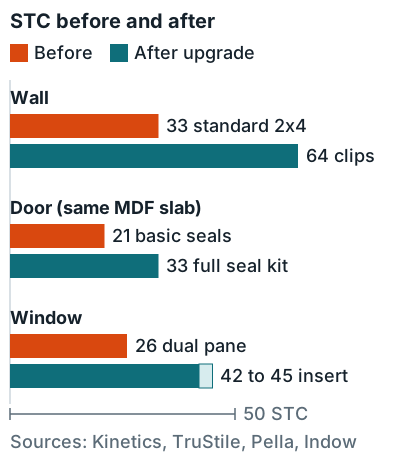
The seals around a door decide its rating more than the door itself. TruStile's ratings for the same 1-3/4 inch MDF door run from STC 21 with a basic seal package to STC 33 with full perimeter seals, a threshold, and a door sweep. The company says it's the gasketing and perimeter sealing that set the rating in the end.
Swap the slab
Solid core
Owens Corning recommends "solid wood core doors" where noise control matters, and says to avoid sliding doors.
Seal the sides and top
Gaskets
Compression seals on the stop close the gaps at the jambs and head.
Seal the bottom
Threshold
A threshold plus a sweep or automatic door bottom closes the biggest gap.
Purpose-built studio doors go much higher. Republic Door's steel sound doors reach STC 52 with seals, gaskets, a threshold, an automatic door bottom, and cam-lift hinges. A panel stuck on the back of a door doesn't count: it adds absorption, not isolation, as explained in can you put acoustic panels on a door.
Windows: inserts and laminated glass
Windows are usually the weakest part of an outside wall. Andersen puts a typical dual-pane window at STC 25 to 30, and Pella says most standard double-pane units with two 3 mm panes rate around STC 26. Three fixes work, cheapest first.
- Weatherstrip and seal. Pella calls airtight seals and lab-tested weatherstripping key to how a window performs.
- Add an interior insert. In tests at the British Columbia Institute of Technology reported by Indow, double-pane windows with inserts reached STC 42 to 45, an average 14 dB better from 125 Hz to 4 kHz.
- Replace the glass. Andersen recommends laminated glass or panes of mismatched thickness, and says going from dual to triple pane won't necessarily buy you the same improvement.
If traffic and street noise are your main problem, they get their own plan in how to soundproof a room from outside noise.
Floor and ceiling
Floors and ceilings carry two kinds of noise: airborne sound, rated by STC, and footsteps and impacts, rated by IIC. A rug with a pad only fixes the second. Owens Corning says carpet and pad greatly improve impact isolation while the airborne STC "is changed very little."
| Ceiling under a hardwood floor on engineered joists (field test) | FSTC | FIIC |
|---|---|---|
| Two layers of 5/8 in Type X drywall on the joists | 54 | 45 |
| Same two layers, hung on IsoMax clips and 7/8 in channel | 61 | 62 |
The clips were the only listed change in that Kinetics field test (AT001096A and B). They added 7 points of airborne isolation and 17 of impact isolation.
Renters can't rebuild walls, so the options you do have are in how to soundproof a room in an apartment. Low-cost fixes are ranked in how to soundproof a room cheaply, and budgets for each level are in how much it costs to soundproof a room. If all you need is a quiet spot to record vocals, a vocal booth is smaller and cheaper than soundproofing a whole room.
FAQ
Can you soundproof a room completely?
No. You reduce sound by a number of decibels, and even a commercial double-wall booth is rated at 33 to 59 dB of reduction, with the smallest reduction at 125 Hz, in the bass.
Do foam panels soundproof a room?
No. Foam and acoustic panels absorb echo inside the room. They don't add the mass, sealing, or decoupling that stops sound from passing through walls.
What is the cheapest way to soundproof a room?
Seal the air gaps first: acoustical sealant around the wall edges, a seal kit on the door, and weatherstripping on the windows. In USG's lab data, one unsealed wall fell from STC 53 to STC 29.
Does insulation in the walls soundproof a room?
It helps, but less than people expect in a standard wood stud wall. National Gypsum measured an 8 point gain from cavity insulation in its test wall, and says spray foam adds little.
What STC rating should a home studio wall have?
Aim for STC 50 or more on walls next to bedrooms or neighbors. National Gypsum notes that's the International Building Code minimum between apartments. Treat STC as a rough guide for music, because ASTM says it isn't meant for musical instruments.
More answers: Home recording FAQ