Best Drum Mics for Home Recording
The best drum microphones for home recording are a Shure Beta 52A on kick, a Shure SM57 on snare, and a RØDE NT5 pair as overheads. Start with three mics (kick, snare, one overhead), go to four for stereo overheads, and close-mic every drum with eight if your room sounds bad.
Quick picks
Each mic covers one job. Specs are from the manufacturer's page or user guide.
| Pick | Job | Type | Key spec | Price band |
|---|---|---|---|---|
| Shure Beta 52A | Kick | Supercardioid dynamic | 174 dB max SPL | Under $200 |
| Shure SM57 | Snare | Cardioid dynamic | 40 Hz to 15 kHz | Under $200 |
| RØDE NT5 | Overheads, hi-hat | Small-diaphragm condenser | Sold as a matched pair | $300 to $500 a pair |
| Sennheiser e604 | Toms | Cardioid, clip-on | Made for toms and snare | Under $200 each |
| Sennheiser e600 kit | All 7 positions | e602-II, 4 e604s, 2 e614s | 7 mics plus clips, one case | $800 to $1,200 |
3, 4 and 8 mic kits
Every mic needs its own preamp, so pick the build your interface can actually run. The 3 and 4 mic layouts match our how to record drums at home guide.
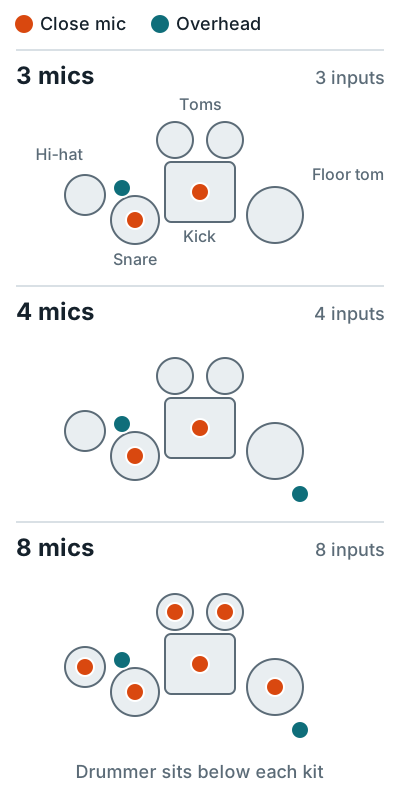
3 mics
Kick, snare, 1 OH
Beta 52A, SM57, and one NT5. You need a 4 preamp interface like the Scarlett 18i16 (listed at $599.99).
4 mics
+ 2nd OH
Swap the single NT5 for a matched pair. It runs on the same 4 preamp interface, with no inputs left over.
8 mics
+ toms, hi-hat
Add three e604s and a third NT5. Now you need 8 preamps, like the Scarlett 18i20 (listed at $829.99).
Kick: Shure Beta 52A
The Shure Beta 52A is a supercardioid dynamic "designed specifically for kick drums and other bass instruments," with a locking stand adapter and XLR built in. Its user guide lists 20 Hz to 10 kHz and a 174 dB max SPL.
Shure gives you two placements: 2 to 3 inches from the beater head, slightly off-center, for "sharp attack," or 8 to 12 inches away on-axis for a balanced sound. Push a pillow or blanket against the beater head to tighten the tone.
On paper it's a low-output mic, at 0.6 mV/Pa, but a kick drum is loud enough that gain is rarely the problem.
Snare: Shure SM57
The Shure SM57 is the snare mic to buy. Shure says it "has pretty much dominated for the better part of 60 years" on snare. The SM57 user guide lists a cardioid dynamic, 40 Hz to 15 kHz, and says to place it 1 to 3 inches above the rim, aimed at the head.
The catch: one snare mic only catches the top head. Shure's drum recording guide adds a second mic underneath for "fizz," with its polarity flipped.
Overheads: RØDE NT5 pair
The RØDE NT5 is a 1/2 inch cardioid condenser that RØDE lists for "drum overheads and cymbals," and it's "available as a certified match pair for stereo recording." Shure's guide says most engineers use a pair of large or small diaphragm condensers on overheads.
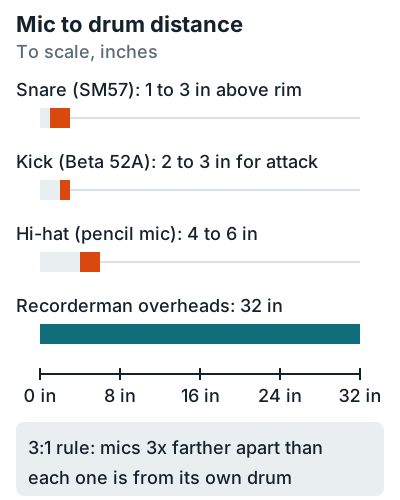
In a small room, set them up as a Recorderman pair: one 32 inches above the snare center pointing down, and one near the drummer's right shoulder, also 32 inches from the snare, per Shure's stereo drum miking guide. The kick has to sit the same distance from both mics.
The catch: they need 48 V phantom power, and a pair is the most expensive part of the 4 mic build.
Toms and hi-hat
Close-mic toms with a clip-on cardioid like the Sennheiser e604, which Sennheiser makes for toms, snares, and percussion. Shure says dynamics are traditionally preferred on toms "mainly because they produce less spill," and the SM57 guide puts tom mics 1 to 3 inches above the head.
The hi-hat usually comes through the overheads. If you want more detail, Shure suggests a pencil condenser roughly 4 to 6 inches (10 to 15 cm) away, pointing down at the far edge, away from the snare.
What changes in a small room
In a small room, move the mics closer and use more of them. Shure recommends the Recorderman pair for "small, untreated rooms that don't sound great," and says techniques like ORTF are "less likely to succeed in a small or untreated space" because they mostly hear reflections.
- Skip room mics. A small room's reflections are the thing you're trying to avoid, so spend those inputs on close mics.
- Close-mic more drums. Shure says close-miking nearly every drum helps "when room acoustics are poor," and that's the job of the 8 mic build.
- Keep the 3:1 spacing. Each mic should sit at least three times farther from the others than from its own drum; see the 3:1 rule.
- Check phase. Bring up the kick, add each track in turn, flip its polarity, and keep whichever version sounds fuller.
Keeping the noise in is a separate job, covered in soundproof drum room. Interfaces with enough inputs are in the best audio interface for home recording. Condenser vs dynamic microphone explains why dynamics go on drums and condensers overhead, and the microphones for home recording hub covers mics for every other source.
FAQ
How many mics do I need to record drums at home?
Three is the useful minimum: kick, snare, and one overhead. Four gives you a stereo Recorderman overhead pair, and eight close-mics every drum for a dry, controllable sound in a small room.
Can I record drums with a 2 input interface?
Only with two mics, such as one overhead and a kick mic. A 3 or 4 mic kit needs four preamps, like the Scarlett 18i16, and an 8 mic kit needs eight, like the Scarlett 18i20.
Do I need condenser mics for drum overheads?
Usually. Shure says most engineers use a pair of large or small diaphragm condensers on overheads, and RØDE lists drum overheads and cymbals as an NT5 application.
Is a drum mic kit better than buying mics separately?
A kit like the Sennheiser e600 is simpler, with 7 mics and clips in one case. Buying separately lets you start with 3 mics and add the rest later.