How Far Off the Wall Should Acoustic Panels Be?
Mount acoustic panels with an air gap at least as deep as the panel is thick, so a 4 inch panel sits 4 inches off the wall. That's the rule of thumb in GIK's panel thickness guide, which adds that gaps work best with 4 or 6 inch panels.
Why a gap adds bass absorption
A porous panel works by slowing moving air, and air moves fastest a quarter wavelength out from the wall. For 100 Hz, GIK notes, that peak is "nearly three feet away from the wall." Pull the panel out and it sits closer to where the bass is actually moving.
For a quarter wavelength, divide the speed of sound by four times the frequency. With the 1,129 ft/s (344 m/s) Genelec uses, that's 34 inches at 100 Hz, 17 inches at 200 Hz, and 7 inches at 500 Hz.
Gap vs thicker panel
A gap helps, but solid thickness helps more. In GIK's words, "a solid eight-inch trap will still outperform a four-inch panel with a gap."
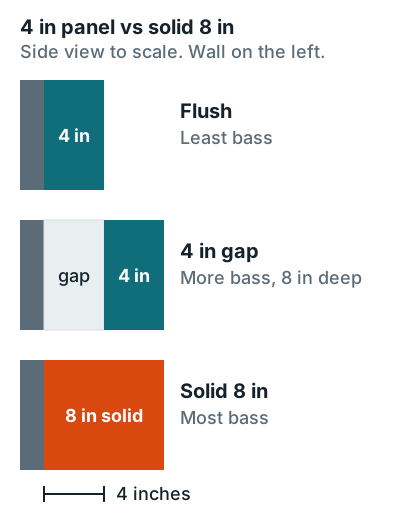
So save the gap for spots where a thicker panel won't fit, or for the wall behind your speakers. Spacer hardware is in how to hang acoustic panels, and thickness in how thick acoustic panels should be. The full plan is in the home studio acoustic treatment guide.
Related questions
Do acoustic panels need an air gap?
No, panels work flush on the wall. A gap only extends absorption lower into the bass, so use one where you can't fit a thicker panel.
Is an air gap as good as a thicker panel?
No. GIK says a solid 8 inch trap still outperforms a 4 inch panel with a 4 inch gap, so buy thicker panels if you have the depth.
Do some panels have a built-in air gap?
Yes. GIK's 242 panel data sheet says the panel has a built-in air gap that increases low end absorption while letting it hang flush on the wall.
More answers: Home recording FAQ