What Is the Difference Between Active and Passive Studio Monitors?
Active studio monitors have their power amplifiers and crossover built into the cabinet, while passive monitors have no amplifier and need a separate power amp. Genelec's 8030C manual describes an active monitor as one that "contains drivers, power amplifiers, active crossover filters and protection circuitry."
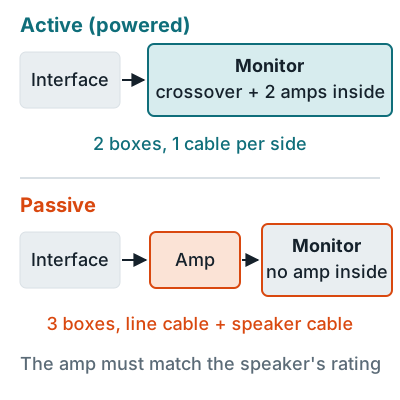
Active vs passive compared
| Active (powered) | Passive | |
|---|---|---|
| Amplifier | Built in, usually one per driver | Separate, bought and matched by you |
| Crossover | Splits the line signal before the amps | Splits the amplified signal after the amp |
| Hookup | Interface to monitor, one cable per side | Interface to amp, then speaker cable to monitor |
| Power | Each monitor plugs into the wall | Only the amp plugs in |
| Example | Yamaha HS5: 45 W + 25 W bi-amp | Amphion One15: 50 to 200 W amp recommended |
Why almost all home studio monitors are active
Active monitors remove the guesswork of pairing an amp. Yamaha says its self-powered MSP5 eliminated the "X-factor" of how a separate amp's quality and rating affects the sound, and pairs built-in amps with a crossover "perfectly matched to the speaker drivers," per Yamaha's monitor history.
Genelec notes that an active crossover works at low signal levels before the amps, while a passive crossover has to handle the amp's high currents and voltages. Passive monitors still suit studios that already own a good amplifier.
Hookup for active pairs is in how to connect studio monitors to a computer, and current picks are in the best studio monitors for home studios.
Related questions
Are powered and active studio monitors the same thing?
Yes, in everyday use. Both mean the amplifier is inside the speaker, so you plug a line-level cable straight in.
Can I plug passive monitors into an audio interface?
Not directly. An interface puts out line level, so a passive monitor needs a power amplifier between them, connected with speaker cable.
Should I buy active or passive monitors for a home studio?
Active. You need fewer boxes and cables, and the amps are already matched to the drivers.
More answers: Home recording FAQ