Closed-Back vs Open-Back Headphones
Use closed-back headphones when a mic is recording and open-back headphones when you mix. Closed cups keep your headphone mix out of the mic and block room noise (up to 32 dB of attenuation on the Sennheiser HD 280 PRO), while open backs give a wider, less colored image for mix decisions. If you can only buy one pair, make it closed-back.
Comparison table
Closed-back wins on isolation and leakage. Open-back wins on spaciousness. That's most of the decision right there.
| Closed-back | Open-back | |
|---|---|---|
| Isolation | Good to excellent; up to 32 dB on the HD 280 PRO | No isolation figure published on the open picks |
| Leak into a mic | Reduced | May bleed into sensitive mics |
| Sound | Cup can be tuned for a specific result | Less coloration, wider and deeper soundstage |
| Weight, matched pair | DT 700 PRO X: 350 g | DT 900 PRO X: 345 g |
| Best for | Tracking vocals and instruments, noisy rooms | Mixing and mastering |
| Example picks | HD 280 PRO, DT 770 PRO, DT 700 PRO X | HD 600, DT 900 PRO X, DT 990 PRO |
The isolation and sound rows come from Audio-Technica's open vs closed explainer, the leakage row from Beyerdynamic's DT 990 PRO FAQ, and the weights from the maker pages linked below.
How the back changes the sound
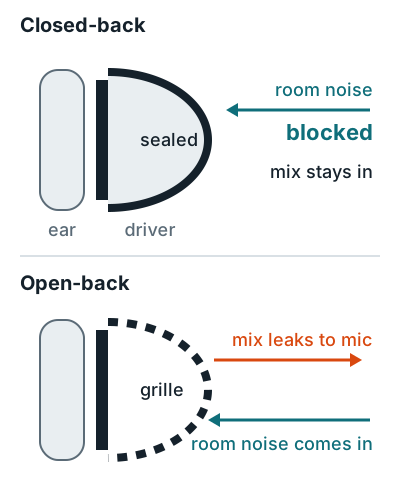
A closed-back cup is a sealed shell behind the driver. An open-back cup is a grille, so sound and air pass through it both ways. Audio-Technica says the sealed cup can be tuned for a specific result, while the open design gives less coloration and better transient response, since there's less air pressure behind the driver.
For tracking: closed-back
Closed-back is the right call whenever a mic is open. Beyerdynamic recommends closed-back headphones for use with a microphone because they reduce leakage into it, and warns that open-back models may bleed into sensitive mics.
Vocals and acoustic guitar
Closed
A sensitive condenser hears the click and backing track coming out of an open pair.
Noisy room or loud drummer
Up to 32 dB
The HD 280 PRO's rated attenuation, the only figure published among the closed picks on this site.
For picks and a 5-minute bleed test, see the best closed-back studio headphones. To set up the headphone mix your singer hears, read how to monitor vocals while recording.
For mixing: open-back
Open-back is the better choice for mix decisions. Beyerdynamic says open headphones are often used for mixing and mastering because of their better spatial representation, and Audio-Technica credits them with increased soundstage width and depth.
Comfort and weight
Open-back pairs are often slightly lighter, but not by much. Audio-Technica says open cups use less material, which helps over long sessions. In Beyerdynamic's matched PRO X pair, the open DT 900 PRO X weighs 12.2 oz (345 g) and the closed DT 700 PRO X 12.3 oz (350 g), both without cable. That gap won't decide anything.
Open DT 900 PRO X
345 g
48 ohms, detachable mini XLR cable.
Closed DT 700 PRO X
350 g
48 ohms, detachable mini XLR cable.
Pad material, clamping force, and how loud you listen decide comfort too. That comparison lives on best studio headphones.
Which should you buy first?
Buy closed-back first, then add an open pair for mixing. A closed pair can do both jobs. An open pair can't track a vocal cleanly.
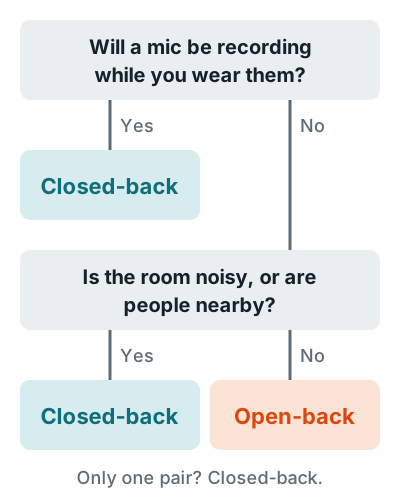
- Track on closed-back. Start with one pair from the closed-back picks and use it for everything.
- Add open-back for mixing when the budget allows, matched to your interface's headphone output.
- Check mixes on monitors. See the best studio monitors for home studios.
FAQ
Is closed-back or open-back better for recording?
Closed-back. Beyerdynamic recommends closed-back headphones whenever a microphone is in use, because open-back models may bleed into sensitive mics.
Is closed-back or open-back better for mixing?
Open-back, if you can choose. Beyerdynamic says open headphones are often used for mixing and mastering because of their better spatial representation.
Do open-back headphones have less bass?
Not by rule. Audio-Technica says a closed cup can be tuned for a specific result and credits open backs with less coloration, so bass depends on each model's tuning, not the back alone.
Are open-back headphones more comfortable?
Often a little lighter, since Audio-Technica says open cups use less material. In a matched pair the gap is small: the open DT 900 PRO X weighs 12.2 oz (345 g) and the closed DT 700 PRO X weighs 12.3 oz (350 g).
Which should I buy if I can only afford one pair?
Closed-back. A closed pair can still mix, but an open pair leaks into the mic when you track vocals.