Best Acoustic Panels for Home Studios
The best acoustic treatment panels for most home studios are GIK's FlexRange Acoustic Panels at the reflection points with FlexRange Bass Trap Panels in the corners: a 3.5 inch panel with an NRC of 1.05, plus traps 5.5 inches deep or more. If you want full lab data by frequency, Primacoustic's Broadway glass fiber panels absorb 0.45 at 125 Hz at 2 inches thick.
Skip the foam bundle. Thick fiberglass panels absorb far more low end than foam of the same thickness, and the lab numbers below show why.
Quick picks
Six options cover pretty much every home studio, from foam for flutter echo to DIY cores you build into frames yourself.
| Pick | Best for | Key spec | Price band |
|---|---|---|---|
| GIK FlexRange Acoustic Panel | Reflection points, most rooms | 3.5 in, NRC 1.05 | $89 to $169 per panel |
| GIK FlexRange Bass Trap Panel | Corners | 5.5, 7.5, or 9.5 in | From $119 per panel |
| Primacoustic Broadway Broadband | Best published low-end data | 0.45 at 125 Hz (2 in) | Dealer quote |
| Auralex ProPanel 2 in | Hardware in the box | 0.65 at 250 Hz, NRC 1.05 | About $190 (2x4 ft) |
| Auralex Studiofoam Wedges 2 in | Flutter echo on a budget | 0.24 at 250 Hz, NRC 0.75 | About $63 (pair of 2x2 ft) |
| DIY Owens Corning 703 or Rockwool | Thick panels you build | 0.56 at 125 Hz (4 in 703) | Materials only |
Absorption compared
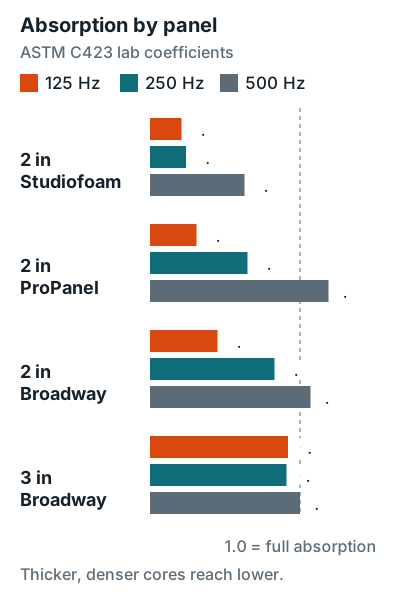
Below 500 Hz, the gap between panels is big, even at the same thickness. The chart uses each maker's ASTM C423 lab results, where 1.0 means the panel absorbs all the sound that hits it.
The 6 best acoustic panels
Every pick is current on its maker's site, and the specs come from the manufacturer's own page or test report, not a reseller listing.
GIK FlexRange Acoustic Panel
For side wall reflection points, the rear wall, and ceiling clouds in most home studios. If you buy one kind of panel, make it this one.
- 2x2, 1x4, 2x3, or 2x4 ft, 3.5 inches thick with a built-in air gap, per GIK's FlexRange panel page
- NRC 1.05, tested at the University of Salford to ISO 354. GIK says it works best from 250 Hz up
- Formerly the GIK 242, built with Knauf insulation per the 242 data sheet
- Rear hanging wire included, ceiling cloud brackets sold separately
The catch: GIK publishes only the NRC, not coefficients by frequency, so you can't compare its low end directly with the chart above.
Price band: $89 to $169 per panel depending on size and options.
GIK FlexRange Bass Trap Panel
For the corners, where bass builds up.
- 5.5, 7.5, or 9.5 inches deep, in 90 Hz, 70 Hz, and 50 Hz tiers, per GIK's bass trap panel page
- Replaces GIK's older 244 and Monster panels
- The same 2x2 to 2x4 ft size range as the acoustic panel
GIK's page gives the 5.5 inch depth in its spec list but 5.25 inches in its description, so confirm the depth before you plan around a tight corner.
Price band: from $119 per panel. Placement and thickness are covered in bass traps.
Primacoustic Broadway Broadband Panel
For anyone who wants full lab data and a high-density core, and doesn't mind asking a dealer for a price.
- 2x4 ft at 1, 2, or 3 inches thick, per Primacoustic's Broadway data sheet
- A 6 pcf glass fiber core, ASTM E84 Class A
- The 2 inch panel absorbs 0.45 at 125 Hz, 0.83 at 250 Hz, NRC 1.00. The 3 inch panel reaches 0.92 at 125 Hz
- Tested at Riverbank Acoustical Laboratories to ASTM C423
Primacoustic's Broadway wall panel page lists the 3 inch panel as "By Request" and the impalers as an add-on, and gives no online price.
Price band: dealer quote.
Auralex ProPanel 2 inch
For buyers who want fiberglass panels with mounting hardware in the box, so there's no second trip to the hardware store.
- 1 inch in 2x2 and 2x4 ft, 2 inches in 2x2, 2x4, and 4x4 ft, per Auralex's ProPanel page
- Absorbs 0.31 at 125 Hz, 0.65 at 250 Hz, 1.19 at 500 Hz, NRC 1.05 in its Riverbank test report
- All components rated Class A per ASTM E84
- Wall mounting hardware included with every panel
Its 125 Hz figure trails Broadway's at the same thickness.
Price band: listed at $191.99 for the 2 inch 2x4 ft panel at the time of writing.
Auralex Studiofoam Wedges 2 inch
For flutter echo and harsh highs when the budget is tight. Just don't expect it to fix your low end.
- 2 inch wedges in 2x2 and 2x4 ft tiles. A box of twelve 2x4s covers 96 sq ft, per Auralex's Studiofoam Wedges page
- Absorbs 0.21 at 125 Hz, 0.24 at 250 Hz, 0.97 at 1 kHz, NRC 0.75 in Auralex's 2 inch wedge test report
- Fire rated UL 94 HF-1
- Mounts with adhesive (Foamtak, Tubetak Pro, or EZ-Stick Pro tabs)
The catch: it does little below 500 Hz, and Auralex's Studiofoam user guide calls its adhesive mounts permanent. Renters, take note.
Price band: listed at $62.99 for a pair of 2 inch 2x2 ft tiles at the time of writing. More in acoustic foam.
DIY: Owens Corning 703 or Rockwool Safe'n'Sound
For building panels thicker than most bought ones, if you don't mind some sawdust.
- Owens Corning 703: 3 pcf fiberglass board. 4 inch board absorbs 0.56 at 125 Hz and 1.26 at 250 Hz, per the 703 data sheet
- Rockwool Safe'n'Sound: 3 inch batts absorb 0.52 at 125 Hz and 0.96 at 250 Hz, flame spread index 0, per Rockwool
You supply the frame, fabric, and tools, and the test data covers the core only, not your finished panel.
The build, step by step, is in how to make acoustic panels.
Foam vs fiberglass vs rockwool
Fiberglass and mineral wool panels absorb far more than foam below 500 Hz at the same thickness. At 2 inches, glass fiber Broadway absorbs 0.83 at 250 Hz and wedge foam 0.24. That's not a close race.
Foam
0.24
2 inch wedges at 250 Hz. Fine for flutter echo, weak in the low mids.
Fiberglass
0.83
2 inch Broadway at 250 Hz. The core of most bought panels.
Rockwool
0.96
3 inch Safe'n'Sound at 250 Hz. A common DIY core.
For more on core materials, see what acoustic panels are made of. For thickness, see how thick acoustic panels should be.
How to choose acoustic panels
Choose by where the panel goes, then by its 125 and 250 Hz figures, then by price. Brand comes last.
- Work out the count. Cover 25 percent of the wall area for a practice or tracking room and 35 percent for mixing. The method is in how many acoustic panels do I need, or use the acoustic panel calculator.
- Buy the corners thick. Bass traps of 4 inches or more go in the corners first.
- Buy reflection panels by the low end. Compare 125 and 250 Hz coefficients, not the NRC.
- Check the fire rating. Look for ASTM E84 Class A or a stated rating like UL 94 HF-1 for foam.
- Plan the mounting. Panels with hardware save a trip. See how to hang acoustic panels.
For where each panel goes, see the home studio acoustic treatment guide. Price ranges for bought and DIY panels are in how much acoustic panels cost.
Where to buy acoustic panels
Buy direct from the maker when you can, so you get the current spec and test data with the product. GIK Acoustics and Auralex both sell on their own websites with listed prices. Primacoustic sells through dealers, with a "Find a Dealer" locator and quote request on its site.
DIY cores like Owens Corning 703 and Rockwool Safe'n'Sound are insulation products, not "acoustic" products, so check that what you buy matches the density and thickness on the data sheet.
FAQ
What are the most effective acoustic panels?
Thick, dense fiberglass or mineral wool panels. Primacoustic's 3 inch Broadway panel absorbs 0.92 at 125 Hz in lab tests, against 0.21 for Auralex's 2 inch wedge foam.
Where can I buy acoustic panels?
GIK Acoustics and Auralex sell direct from their own websites with listed prices. Primacoustic sells through dealers, with a dealer locator and quote request on its site.
Are fiberglass panels better than foam?
Below 500 Hz, yes. At 2 inches thick, Primacoustic's glass fiber Broadway panel absorbs 0.83 at 250 Hz and Auralex's wedge foam 0.24.
Can I compare GIK's NRC with other brands?
Only roughly. GIK tests at the University of Salford to ISO 354, while Auralex and Primacoustic publish ASTM C423 results from Riverbank Acoustical Laboratories.
How many acoustic panels should I buy?
Enough to cover 25 percent of the wall area for a practice or tracking room and 35 percent for a mixing room. In a 12 by 10 by 8 foot room that's 11 or 16 two by four foot panels.