Best Studio Monitors for Home Studios
The best studio monitors for most home studios are a pair of 5-inch powered monitors: the JBL 305P MkII reaches 49 Hz within plus or minus 3 dB and costs under $250 per speaker. For a step up in accuracy, the Neumann KH 120 II holds plus or minus 3 dB from 44 Hz to 21 kHz and can auto-calibrate to your room with Neumann's MA 1 software. Match the monitor to your room size first, then to your budget.
Bigger isn't automatically better here. In a bedroom, a 5-inch pair is easier to place well.
Quick picks
Six monitors cover home studios from a bedroom desk to a treated spare room. Prices are per speaker, and you need two, so double every number before you set a budget.
| Pick | Best for | Low end (dB basis) | Price band |
|---|---|---|---|
| JBL 305P MkII | Small rooms, tight budgets | 49 Hz (plus or minus 3 dB) | Under $250 |
| Adam T5V | Small rooms, ribbon tweeter | 45 Hz (minus 6 dB) | Under $250 |
| Yamaha HS5 | Small rooms, flat-voiced classic | 74 Hz (minus 3 dB, HS5I spec) | Under $250 |
| Yamaha HS8 | Medium to large rooms | 47 Hz (minus 3 dB, HS8I spec) | $300 to $500 |
| Neumann KH 120 II | Accuracy with room calibration | 44 Hz (plus or minus 3 dB) | $700 to $1,000 |
| Genelec 8030C | Tight tolerance, compact cabinet | 54 Hz (plus or minus 2 dB) | $1,000 to $1,500 |
Pick monitors by room size
Size the listening triangle to the room first, then pick a monitor that suits that distance. Adam Audio's monitor positioning guide says the monitor spacing and your listening distance should stay under about one third of the room's average length and width.
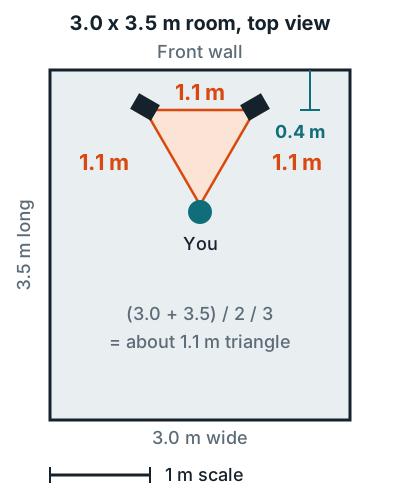
Small room
Up to 3.6 ft (1.1 m)
Bedrooms around 10 by 11.5 ft (3 by 3.5 m). Get a 5-inch pair: JBL 305P MkII, Adam T5V, Yamaha HS5, Neumann KH 120 II, or Genelec 8030C.
Medium room
3.6 to 4.9 ft (1.1 to 1.5 m)
Spare rooms around 13.1 by 16.4 ft (4 by 5 m). A 5-inch pair still works, and a 6.5 to 7-inch pair like the JBL 306P MkII or Adam T7V adds low end.
Larger room
4.9 ft (1.5 m) or more
Rooms where you can sit 4.9 ft (1.5 m) back and keep the monitors 4.9 ft (1.5 m) off the walls. This is where the 8-inch Yamaha HS8 makes sense.
Yamaha's HS series manual asks for at least 4.9 ft (1.5 m) between the speakers and any wall or corner, and says to use the Room Control switch when you can't manage that. Most bedroom desks can't. That's why the 8-inch HS8 sits in the larger-room column.
How to read monitor frequency response
A low-frequency spec only means something next to its dB figure. Makers quote the low end at different points (plus or minus 3 dB, minus 6 dB, or minus 10 dB), and the deeper the dB figure, the lower the number looks.
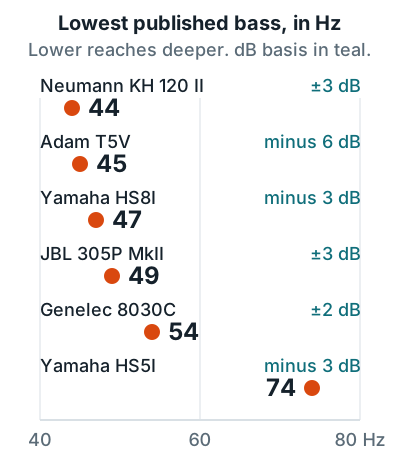
The tolerance matters as much as the end points. Genelec specifies the 8030C at 54 Hz to 20 kHz within plus or minus 2 dB, a tighter window than the plus or minus 3 dB that JBL and Neumann use. A spec with no dB figure at all tells you nothing about how flat the monitor is. Treat it as marketing.
The 6 best studio monitors
Every pick is a current powered two-way monitor, with specs from the maker's own product page.
JBL 305P MkII
For a first pair in a small room, where the desk sits near a wall.
- 49 Hz to 20 kHz, plus or minus 3 dB, and 43 Hz at minus 10 dB, per JBL's 305P MkII page
- 5-inch woofer and 1-inch soft dome, driven by 41 W plus 41 W Class D
- 94 dB continuous max SPL, 108 dB peak
- Boundary EQ shelf at 50 Hz (0, minus 1.5, or minus 3 dB) and HF trim of plus or minus 2 dB
Price band: under $250 per speaker.
Adam T5V
For a small room where you want a ribbon tweeter and shelving EQ at both ends.
- 45 Hz to 25 kHz at minus 6 dB, per Adam's T5V page
- 5-inch woofer and 1.9-inch U-ART ribbon tweeter, with 50 W plus 20 W
- 106 dB or more max SPL per pair at 1 meter
- Low shelf below 300 Hz and high shelf above 5 kHz, each plus or minus 2 dB
The catch: Adam publishes only a minus 6 dB figure, so you can't compare its flatness directly with JBL's or Neumann's tolerance specs.
Price band: under $250 per speaker.
Yamaha HS5
For a small room, and for anyone who wants the long-running HS voicing.
- 54 Hz to 30 kHz at minus 10 dB; the HS5I version lists 74 Hz to 24 kHz at minus 3 dB, per Yamaha's HS series page
- 70 W total (45 W low, 25 W high)
- Room Control cuts below 500 Hz by 2 or 4 dB, and High Trim adjusts above 2 kHz by plus or minus 2 dB
- 6.7 by 11.2 by 8.7 in (170 by 285 by 222 mm), 11.7 lb (5.3 kg)
The catch: 74 Hz at minus 3 dB is the shallowest bass here, so check your low end on headphones too.
Price band: under $250 per speaker.
Yamaha HS8
For a medium or larger room where the monitors can sit well off the walls.
- 38 Hz to 30 kHz at minus 10 dB; the HS8I lists 47 Hz to 24 kHz at minus 3 dB
- 120 W total (75 W low, 45 W high)
- 9.8 by 15.4 by 13.1 in (250 by 390 by 334 mm), 22.5 lb (10.2 kg), per Yamaha's HS specs
At 22.5 lb (10.2 kg) each and 15.4 in (390 mm) tall, the HS8 needs sturdy stands. Without Yamaha's 4.9 ft (1.5 m) wall clearance, you'll be leaning on Room Control to tame the bass.
Price band: $300 to $500 per speaker.
Neumann KH 120 II
For a home studio that wants measured accuracy and automatic room correction.
- 44 Hz to 21 kHz, plus or minus 3 dB, per Neumann's KH 120 II page
- Unit matching within plus or minus 0.45 dB from 100 Hz to 10 kHz across every unit made
- 5.25-inch woofer and 1-inch tweeter, with 145 W plus 100 W
- DSP with MA 1 automatic monitor alignment for room calibration (MA 1 sold separately)
Price band: $700 to $1,000 per speaker.
Genelec 8030C
For a small, treated room where you want the tightest published tolerance.
- 54 Hz to 20 kHz, plus or minus 2 dB, and 47 Hz at minus 6 dB, per Genelec's 8030C page
- 130 mm woofer and 19 mm metal dome, with 50 W plus 50 W
- 104 dB short-term sine output per speaker at 1 meter, and 110 dB peak per pair
- 11.2 by 7.4 by 7 in (285 by 189 by 178 mm), 11 lb (5 kg), with rear-panel room compensation switches
Price band: $1,000 to $1,500 per speaker.
Getting a flat response in a small room
In a small room, where you put the monitors changes the bass more than which of two good monitors you bought. Adam's guide says each nearby wall can lift the bass by 0 to 4 dB, so a monitor in a corner gets two boosts.
This part costs nothing.
- Pick your wall distance. Adam advises either under 1.6 ft (0.5 m) from the wall behind the monitors, with boundary EQ on, or more than 4.9 ft (1.5 m). Avoid the distances in between.
- Set the room switch to match. On a JBL 305P MkII near a wall, start at minus 1.5 dB on the boundary EQ. On a Yamaha HS, start at minus 2 dB on Room Control.
- Put the tweeters at ear height. Yamaha's manual puts the listener at the point of an equilateral triangle, with the tweeters at ear height.
- Keep the setup symmetrical. Match the distance from each monitor to its side wall.
The full placement walkthrough is in how to set up studio monitors, and treating first reflections is covered in the home studio acoustic treatment guide.
Monitor and headphone guides
Everything else on choosing, connecting, and living with monitors and headphones is on these pages.
Headphones
Best studio headphones
Best closed-back headphones
Best open-back headphones
Closed-back vs open-back
Monitors are one part of the home recording equipment list, and the audio interface guide covers the outputs that feed them.
FAQ
What size studio monitors do I need for a small room?
Work out the listening triangle first: Adam Audio advises keeping monitor spacing under one third of the room's average length and width. A 10 by 11.5 foot (3 by 3.5 m) bedroom gives a triangle of about 3.6 ft (1.1 m), which suits 5-inch monitors like the JBL 305P MkII or Adam T5V.
Are 8-inch monitors too big for a home studio?
Not if you can keep them at least 4.9 ft (1.5 m) from walls and corners, which is what Yamaha's HS manual asks for. With the desk against a wall, each nearby wall adds 0 to 4 dB of bass per Adam Audio, so a 5-inch pair is easier to get right.
How do I compare studio monitor frequency response specs?
Check the dB figure next to the low number. Yamaha lists the HS5 at 54 Hz at minus 10 dB and its HS5I twin at 74 Hz at minus 3 dB, while JBL quotes the 305P MkII at 49 Hz within plus or minus 3 dB.
What is the best studio monitor under $250?
The JBL 305P MkII, Adam T5V, and Yamaha HS5 are all 5-inch monitors in the under $250 per speaker band. The JBL reaches lowest at the plus or minus 3 dB point (49 Hz) and has a boundary EQ for desks near a wall.
Do I need a subwoofer with home studio monitors?
Most home studios don't. A 5-inch pair like the JBL 305P MkII already reaches 49 Hz within plus or minus 3 dB, and in a small room each nearby wall adds 0 to 4 dB of bass, per Adam Audio's positioning guide.