Best Budget Microphone for Recording Vocals
The best budget microphone for recording vocals is the Shure SM58 if your room is untreated and the Audio-Technica AT2020 (listed at $119) if it's quiet and treated. Under $100, get the Sennheiser e835. No interface yet? The AT2005USB or AT2020USB-X plugs straight into your computer.
The short version: buy for the room you actually sing in, not the room you wish you had.
Quick picks
Here are six current budget mics and one reference mic, with specs pulled from each maker's own page.
| Pick | Type | Best for | Key spec | Price band |
|---|---|---|---|---|
| Sennheiser e835 | Dynamic, XLR | Bare rooms, under $100 | 2.7 mV/Pa | Under $100 |
| Audio-Technica AT2005USB | Dynamic, USB and XLR | No interface, under $100 | 16-bit, 48 kHz USB | Under $100 |
| Shure SM58 | Dynamic, XLR | Bare rooms, best overall | Built-in pop filter | $100 to $200 |
| Audio-Technica AT2020 | Condenser, XLR | Quiet, treated rooms | 20 dB SPL self-noise | $100 to $200 |
| Audio-Technica AT2035 | Condenser, XLR | Loud singers, treated rooms | 10 dB pad, 80 Hz cut | $100 to $200 |
| Audio-Technica AT2020USB-X | Condenser, USB | No interface, quiet rooms | 24-bit, 96 kHz | $100 to $200 |
| Neumann TLM 103 (reference) | Condenser, XLR | The $1,000 benchmark | 7 dB-A self-noise | Over $1,000 |
Best under $100
Under $100, buy a dynamic. It needs no phantom power, and it hears less of an untreated room.
Sennheiser e835
2.7 mV/Pa
Cardioid dynamic, 40 Hz to 16 kHz, per Sennheiser. Hotter than the SM58's 1.6 mV/Pa, so it asks a little less of your preamp. You'll need an interface.
Audio-Technica AT2005USB
USB + XLR
Cardioid dynamic with a headphone jack, per Audio-Technica. USB records 16-bit at 44.1 or 48 kHz, and the XLR output still works when you add an interface later.
The catch: both are stage-style dynamics that roll off above 15 to 16 kHz. If you sing soft and breathy, you'll lose some of the air a condenser would catch.
Best under $200
Between $100 and $200, you get to choose by room: a dynamic for bare walls, or a condenser for a quiet, treated space.
Shure SM58: best for a bare room
The Shure SM58 is a cardioid dynamic with a built-in spherical pop filter and pneumatic shock mount, which Shure designed for "live performance, sound reinforcement, and studio recording." Its user guide lists 50 Hz to 15 kHz and 1.6 mV/Pa.
Watch for proximity effect. At close range a cardioid boosts bass by 6 to 10 dB below 100 Hz, per the same guide, so back off a little if your voice gets boomy.
Audio-Technica AT2020: best for a treated room
The AT2020 is a cardioid condenser, listed at $119, with 20 Hz to 20 kHz response, 14.1 mV/Pa sensitivity, and a 144 dB SPL ceiling. It needs 48 V phantom power.
In a treated corner, its 20 kHz top end reaches past the SM58 (15 kHz) and the e835 (16 kHz).
The catch: there's no pad or low-cut switch, and at 20 dB SPL it's the noisiest condenser here.
Audio-Technica AT2035: best for loud singers
The AT2035, listed at $159, fixes both AT2020 limits: 12 dB SPL self-noise, a switchable 10 dB pad (148 dB SPL max, 158 dB with the pad), and an 80 Hz low-cut. A shock mount is in the box, too.
It's still a condenser, so it needs a quiet room and phantom power (11 to 52 V).
Audio-Technica AT2020USB-X: best without an interface
The AT2020USB-X, listed at $169, is a cardioid condenser that records up to 24-bit, 96 kHz over USB-C, with a 3.5 mm headphone output and volume control.
It's USB-C only, with no XLR output, so it can't move to an interface later. If you think you'll want an interface down the road, that matters. The math is worked out in XLR vs USB microphone.
Budget mics vs a $1,000 reference
A $1,000 condenser is mostly quieter and a little more sensitive. The Neumann TLM 103 lists 7 dB-A self-noise and 23 mV/Pa, against the AT2020's 20 dB SPL and 14.1 mV/Pa.
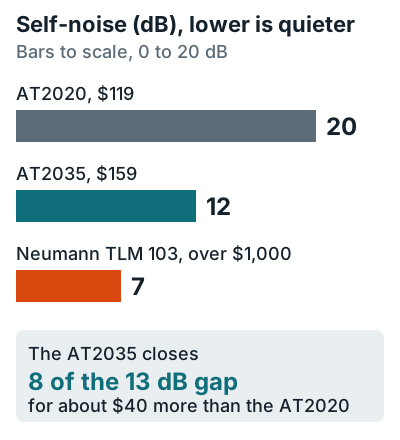
Self-noise only matters when your room is quieter than the mic. Shure's vocal guide says that in a reflective room "upgrading your equipment alone is unlikely to solve the problem." So a budget mic plus treatment beats a TLM 103 in a bare room.
How to choose a budget vocal mic
Pick by interface first, then by room, then by voice.
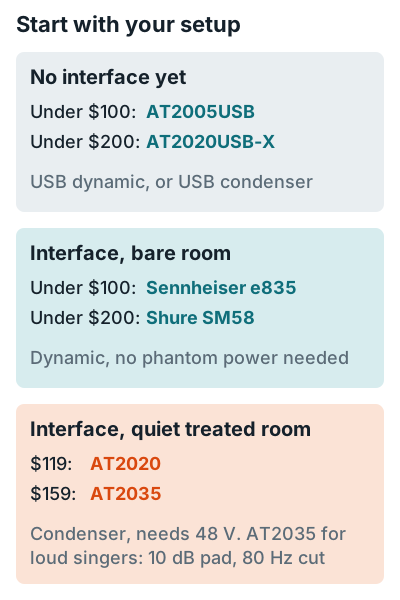
- Check your interface. No interface means USB. A dynamic needs plenty of gain, so see do I need a preamp to record vocals.
- Check your room. Bare walls and a hard floor mean a dynamic. The tradeoff is laid out in condenser vs dynamic microphone.
- Check your voice. If you belt in a treated room, get the AT2035 for its pad and low-cut.
- Budget for a pop filter. The SM58 has one built in. For the condensers, see best pop filters, because plosives will find you.
For a full low-cost setup, see how to build a home studio on a budget. Mics for acoustic guitar and every other source are in the microphones for home recording hub.
FAQ
What is the best cheap microphone for recording vocals?
The Shure SM58 if your room is untreated and the Audio-Technica AT2020 if it's quiet and treated. Both sit in the $100 to $200 band.
Is there a good vocal mic under $100?
Yes, a dynamic: the Sennheiser e835 for an interface, or the Audio-Technica AT2005USB if you have no interface, since it has both USB and XLR outputs.
How much better is a $1,000 mic than a budget one?
On paper, the Neumann TLM 103 is 13 dB quieter than the AT2020 and about 4 dB more sensitive. In an untreated room you'll hear the room before you hear that difference.
Do cheap condenser mics need phantom power?
Yes over XLR. The AT2020 needs 48 V and the AT2035 11 to 52 V, both supplied by the interface. USB condensers like the AT2020USB-X are powered by the USB port.
Should I buy a cheap mic or treat my room first?
With a dynamic, the mic first, because it rejects the room. With a condenser, treat the room, since Shure says better gear alone won't fix a reflective room.