Best Studio Desks for Home Studios
The best studio desk is one at least 46 inches wide, which fits two 5 inch monitors spaced 39 inches (1 meter) apart, with rack space for your interface. The Gator Frameworks Elite desk (47.2 inches, up to 8U of rack) is the best value. Under $300, a 63 inch IKEA TROTTEN gets you the most width for the money.
Width is the number that matters. Cool-looking angled wings won't fix monitors jammed too close together.
Quick picks
Six desks cover home studios from a first setup to a full mixing room. Prices are the makers' listed prices at the time of writing.
| Pick | Best for | Width | Rack space | Listed price |
|---|---|---|---|---|
| IKEA TROTTEN 160x80 | Under $300, widest top | 63 in | None | $209.99 |
| On-Stage WS7500 | Small rooms, raised monitor shelf | 43 in | None | $349.95 |
| Gator Content Furniture Desk | Small rooms with an interface rack | 43 in | 3U | $359.99 |
| Gator Elite Furniture Desk | Best value overall | 47.2 in | Up to 8U | $629.99 |
| On-Stage WS7700B | Wider monitor spacing | 56 in | 6U | $698.95 |
| Argosy HALO | Premium, large rooms | 79.7 in | 2 x 8U | $1,999.99 (sale) |
How wide should a studio desk be?
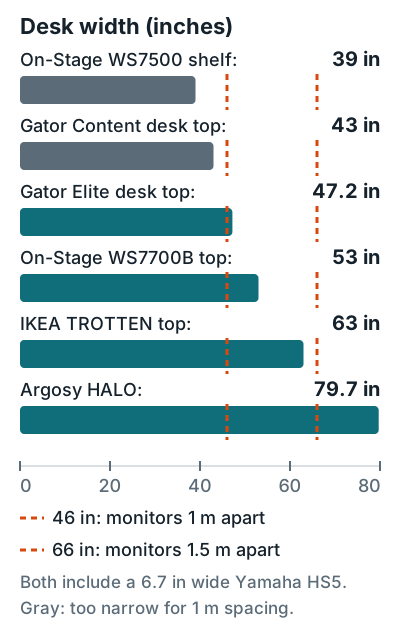
A studio desk needs to be as wide as your monitor spacing plus one monitor's width. Your monitors and your head should form an equilateral triangle, and ADAM Audio calls 59 inch (1.5 m) spacing typical for compact studios, with as little as 39 inches (1 m) workable in very small rooms.
Take a Yamaha HS5, which is 6.7 inches (170 mm) wide. At 39 inch (1 m) spacing you need 46 inches, and at 59 inches (1.5 m) you need 66 inches. An 8 inch HS8 is 9.8 inches (250 mm) wide, which adds 3 inches to each.
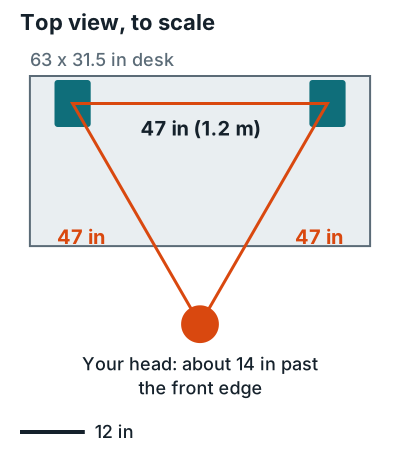
Depth matters less than you'd think, because you end up sitting past the desk's front edge anyway. On a 31.5 inch deep desk with monitors at the back edge, 47 inches (1.2 m) apart, your head lands about 14 inches in front of the desk.
The full placement steps are on how to set up studio monitors.
The 6 best studio desks
Each pick is current on its maker's site, with specs from the manufacturer's own product page.
IKEA TROTTEN 160x80
The TROTTEN is the under $300 pick because no dedicated studio desk at that price comes close to its width. IKEA lists it at 63 x 31.5 inches for $209.99, wide enough for 55 inch (1.4 m) monitor spacing with HS5s.
The catch: no rack, no keyboard tray, and no monitor shelf. When you need rack space, pair it with the Gator Elite 10U rack table, listed at $269.99.
On-Stage WS7500
The WS7500 suits a small room where the monitors need to sit up high. On-Stage lists a 43 x 24 inch desktop at 29 inches, a 39 x 17 inch monitor shelf at 37.5 inches, a 27 x 15 inch keyboard tray, and a 175 lb capacity.
The 39 inch shelf limits 5 inch monitors to about 31.5 inch (0.8 m) spacing, and there's no rack. Listed at $349.95.
Gator Frameworks Content Furniture Desk
The Content desk is the cheapest dedicated desk here with a rack. Gator lists 3U of rack under the top, a 43 x 14 inch upper platform, a slide-out keyboard tray, and a 350 lb capacity.
At 43 inches, it's 3 inches short of the 46 inches that 39 inch (1 m) monitor spacing needs. Listed at $359.99.
Gator Frameworks Elite Furniture Desk
The Elite is the best value: it's the narrowest desk here that fits 39 inch (1 m) spacing, and it has real rack space. Gator lists a 47.2 x 30 inch footprint, up to 8U of rack as two 4U bays or one 4U center bay, and a soft-close tray for 49-key controllers that holds 35 lb.
The tray won't take a 61-key controller. Listed at $629.99.
On-Stage WS7700B
The WS7700B gets you wider monitor spacing at a mid-range price. On-Stage lists a 56 inch width, a 53 inch upper surface, 6U of rack (3U each side), and a 175 lb capacity.
The catch: the racks are 9.5 inches deep, too shallow for deep interfaces (see rack space below). Listed at $698.95.
Argosy HALO
The HALO is the premium pick for a dedicated mixing room. Argosy lists the base desk at 79.7 x 35.5 inches with dual 8-space rack bays and a padded armrest. The HALO.K version, at the same price, fits most 61-note controllers.
Speaker mounts only come in the Plus and Ultimate packages. Listed at $1,999.99, a sale price down from $2,299.99.
How much rack space do you need?
You need one rack space (1U) per rackmount unit you own, plus one or two spare. A 1U interface like the Focusrite Scarlett 18i20 fits any desk here with a rack. A desktop interface like a Scarlett 2i2 doesn't need a rack at all, so don't pay for bays you'll fill with snacks.
How to choose a studio desk
Choose by monitor placement first, then rack space, then keyboard size.
- Decide where the monitors go. On the desk, you need spacing plus one monitor width. On stands behind the desk, as Genelec recommends, any width works.
- Raise monitors to ear height. ADAM notes that monitors on a desk almost always sit below ear height. A raised shelf or angled pads fix that.
- Count rack units and depth. Add up your rackmount gear in U, and its depth in inches.
- Match the keyboard tray. The Gator Elite tray takes 49 keys. For 61 or 88 keys, look at the HALO.K or HALO K88.
A desk is one line on the home recording equipment list. If you clamp a mic stand arm to the desk, check that the top is under 2.8 inches (70 mm) thick, the Rode PSA1+ clamp's limit. Layout ideas for the rest of the room are on home studio design and layout.
FAQ
How wide should a studio desk be?
At least 46 inches if your monitors sit on the desk, which fits a 39 inch (1 meter) equilateral triangle with 5 inch monitors. For 59 inch (1.5 meter) spacing you need about 66 inches.
Do I need a dedicated studio desk?
No. A plain desk at least 46 inches wide works, and you can add a separate rack table. Studio desks add rack bays, keyboard trays, and a raised monitor shelf in one frame.
How many rack spaces do I need?
Count the rackmount gear you own or plan to buy and add one or two spaces. A Focusrite Scarlett 18i20 interface takes 1U, so a 3U desk fits it with room for two more 1U units.
Should studio monitors sit on the desk?
Genelec recommends stands behind the desk, high enough that the desk doesn't block the woofer, because a desk under the monitors can vibrate and color the sound. If they stay on the desk, raise or angle them to ear height.