Home Studio Design and Layout
Good recording studio design in a home room comes down to four placements: face the short wall, sit about 38 percent of the room's length from the front wall, put the monitors and your head in an equilateral triangle, and put absorbers at the first reflection points and in the corners. The first three cost nothing.
Which wall should the desk face?
Face the short wall, so the room's long dimension runs from your monitors to the wall behind you. GIK Acoustics measured a 17 by 13 by 8 foot room both ways. Facing the long wall gave a 30 dB range between bass peaks and nulls, and facing the short wall cut it to about 16 dB.
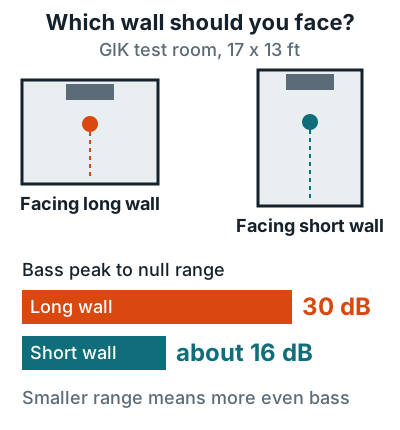
Pick the orientation first and treat second. GIK's advice is to fix the layout, then use bass traps on whatever peaks and nulls are left. Moving the desk is free, and panels aren't.
Where to put the desk and chair
Center the desk on the front wall's width, so both monitors sit the same distance from their side walls. Then slide your chair, not the desk, until your head is near 38 percent of the room's length from the front wall.
| Room length | 38% from front wall |
|---|---|
| 10 ft | 3.8 ft |
| 12 ft | 4.6 ft |
| 14 ft | 5.3 ft |
| 16 ft | 6.1 ft |
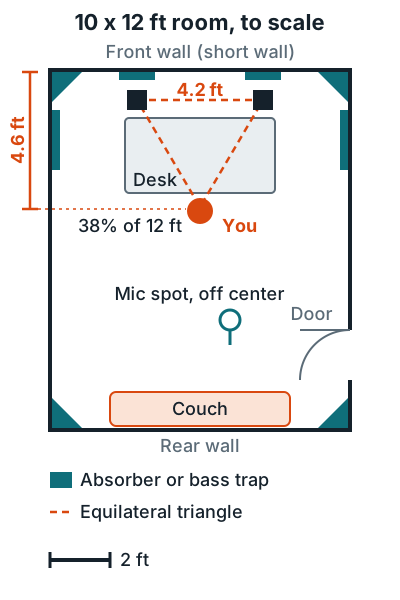
Why 38 percent works, and how to test small moves around it, is on the 38 percent rule page. Neumann's home studio room guide gives the plain version: don't sit in the middle of the room.
How to place the monitors
Put each monitor on a stand behind the desk, close to the front wall, with the two monitors and your head forming an equilateral triangle. The spacing follows from where you sit. In the plan above, the monitors are 4.2 feet apart because that's the side length that reaches a head 4.6 feet from the wall.
Ideal
Under 8 in
Genelec: a monitor front under 8 inches (20 cm) from the wall leaves its bass response unaltered.
Limit
2 ft
Genelec: keep the front within 2 feet (0.6 m) of the wall to avoid a bass cancellation notch.
Minimum gap
2 in
Leave 2 inches (0.05 m) behind a rear-ported monitor so the port has room to breathe.
Those figures come from Genelec's back wall cancellation note, which shows a monitor 34 inches out from the wall getting its first notch near 100 Hz. That's the "my mixes have no low end" problem in a sentence. Genelec also recommends stands behind the desk over the desktop, high enough that the desk doesn't block the woofer. Exact angles, tweeter height, and cabling are in how to set up studio monitors.
Where the computer screen goes
Center the screen between the monitors and below the line between the tweeters, so it doesn't block their path to your ears. OSHA's workstation guide puts the screen 20 to 40 inches from your eyes with its top at or slightly below eye level.
Keep the desk surface clear in front of the monitors. Genelec measured comb filtering near 1 kHz from a monitor's reflection off a large desk, and a stand behind the desk avoids it.
Where acoustic treatment goes in the layout
Plan treatment around the layout in this order: corners for bass, side walls for first reflections, then the wall behind the monitors. Each step below maps to a spot on the plan.
- Corners first. GIK says bass builds up most in corners, and that 4 inch absorbers reach below 100 Hz where a 2 inch panel stops near 300 Hz. See bass traps.
- Side wall reflection points. Sit in your chair while a helper slides a mirror along each side wall. Wherever you see a monitor is a first reflection point. In the 12 foot plan, it lands about 2.3 feet from the front wall.
- Behind each monitor. Neumann's room guide starts with one panel directly behind each speaker, then one or two more between them if needed.
- Use furniture at the back. Neumann notes a couch can act as a broadband absorber, so put it in a rear corner or along the rear wall.
How many panels and which ones to buy is covered in where to place acoustic panels and the home studio acoustic treatment guide. Treatment controls sound inside the room. Keeping sound in or out is soundproofing a home studio, and that's a separate job.
Where to record in the same room
Record in the rear half of the room, away from the desk, out of the corners, and slightly off center. Neumann's vocal recording guide says to avoid room corners and reflective surfaces, but not to stand in the exact center either.
Distance from the desk also keeps computer fan noise off the vocal mic, which Neumann flags as a common home studio problem. If the room is too live for vocals, a vocal booth or a corner of soft furnishings behind the singer fixes it without touching the mix layout.
For a full gear and setup walkthrough, start with how to set up a home recording studio. Layouts for specific rooms are in home studio ideas and bedroom studio setup, and the home recording studio guide links every topic.
FAQ
Should my studio desk face the long wall or the short wall?
The short wall. In GIK Acoustics' 17 by 13 foot test room, facing the short wall cut the spread between bass peaks and nulls from 30 dB to about 16 dB.
How far from the wall should my desk be?
Far enough that your head sits about 38 percent of the room length from the front wall, for example 4.6 feet in a 12 foot room. The monitors stay close to the wall behind them, within 2 feet.
Can I put my desk in a corner?
Avoid it. Bass builds up most in corners, and a corner layout puts one monitor near a side wall and the other in open space, which wrecks left and right symmetry.
Where should the computer screen go?
Centered between the monitors, 20 to 40 inches from your eyes with the top of the screen at or slightly below eye level, which is OSHA's workstation guidance.
What size room is best for a home studio?
The largest rectangular room you can use. A longer room lets you sit farther from the front wall and gives bass room to decay behind you.