Should I Put Acoustic Panels Behind Speakers?
Yes. Put a thick acoustic panel on the wall behind each speaker. That front wall reflects bass back into the monitor's direct sound and cuts a dip in the low end. Neumann's home studio acoustics guide gives "one absorber behind each loudspeaker" as the starting point.
Why the wall behind the speakers matters
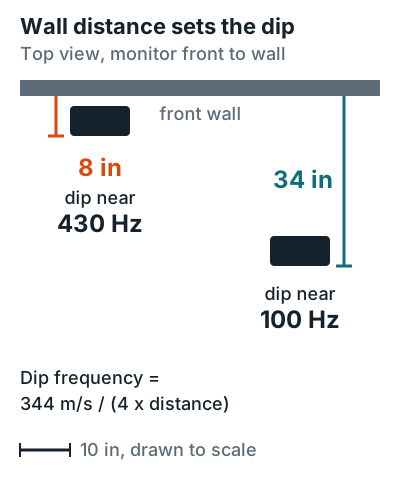
Bass spreads out in every direction from a monitor, so it hits the wall behind it and comes back out of phase at one frequency. That cancellation is called SBIR (speaker boundary interference response), and Genelec's back wall cancellation note puts its first dip at the speed of sound divided by four times the distance from the front of the monitor to the wall.
What to put there
Go at least 4 inches thick, since the dip sits in the bass and low mids. GIK's bass trap guide says a 2 inch absorber rolls off around 300 Hz, while a 4 inch one works under 100 Hz.
Monitors near the wall
Under 8 in
Dip moves to 430 Hz or higher. A 4 inch panel behind each speaker covers it.
Monitors farther out
2 to 3 ft
Dip lands near 95 to 140 Hz. Use the thickest panel or bass trap you can fit.
How thick acoustic panels should be covers thickness, and the home studio acoustic treatment guide has the full plan.
Related questions
What is SBIR?
Speaker boundary interference response is the dip you get when bass bouncing off a nearby wall arrives out of phase with the sound coming straight from the speaker. The wall behind the monitors usually causes the biggest one.
How far should studio monitors be from the wall?
Genelec recommends either under 8 inches (20 cm), which pushes the dip up to 430 Hz or higher, or a front wall distance typically under about 24 inches (0.6 m), with at least 2 inches (5 cm) clearance for a rear port.
Will acoustic foam behind speakers help?
Thin foam does little at the frequencies SBIR affects. GIK says a 2 inch absorber rolls off around 300 Hz, while a 4 inch one works under 100 Hz.
More answers: Home recording FAQ