Best Audio Interface for Home Recording
The best audio interface for most home studios is the Focusrite Scarlett 2i2 4th Gen: two mic preamps with 69 dB of gain, two guitar inputs, and bus power from one USB-C cable. If you only ever record your own voice, the 1-input Scarlett Solo does the job for less. Recording drums or a band, you need the 8-preamp Scarlett 18i20.
One honest note before the list: at these prices, interfaces sound more alike than the marketing suggests. Choose on inputs and features, not on "sound."
Quick picks
Pick by how many mics you'll record at the same time, then by budget. Getting that order backward is how people end up buying twice.
| Pick | Best for | Mic preamps | Preamp noise (EIN) | Price band |
|---|---|---|---|---|
| Focusrite Scarlett Solo 4th Gen | One voice or one guitar | 1 | minus 127 dBu | $150 to $200 |
| Focusrite Scarlett 2i2 4th Gen | Most home studios, beginners | 2 | minus 127 dBu | $200 to $250 |
| MOTU M2 | Low noise, clear metering | 2 | minus 129 dBu | $150 to $250 |
| Universal Audio Volt 2 Gen 2 | Vocals, bundled UA plugins | 2 | Not published | $250 to $300 |
| MOTU M4 | 2 mics plus a keyboard | 2 (+2 line) | minus 129 dBu | $200 to $300 |
| Focusrite Scarlett 18i16 4th Gen | Small drum kits, duos | 4 | minus 127 dBu | $500 to $650 |
| Focusrite Scarlett 18i20 4th Gen | Full drum kits, bands | 8 | minus 127 dBu | $750 to $900 |
On a tighter budget, see the best audio interface under $150. If you mostly record guitar, go to the best audio interface for guitar.
How many inputs do you need?
Count the mics and instruments you record at the same moment. You need one input for each. If you overdub one part at a time, one or two inputs cover you, however many instruments you play.
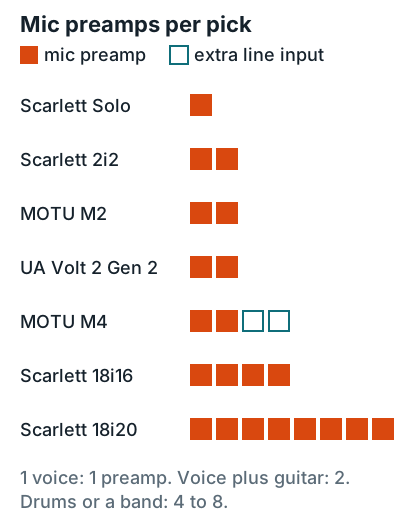
Solo vocals, voice over
1 input
Scarlett Solo. One mic, one track at a time.
Sing and play, podcasts
2 inputs
Scarlett 2i2, MOTU M2, Volt 2 Gen 2, or MOTU M4.
The 7 best audio interfaces for home recording
Every pick is current on its maker's site, and every spec below comes from the manufacturer's own product page, not a reseller listing.
Focusrite Scarlett Solo 4th Gen
For one voice or one guitar, recorded one at a time.
- 1 mic preamp with 57 dB of gain and 1 instrument input at 1 megohm, per Focusrite's Scarlett Solo page
- Minus 127 dBu EIN, A-weighted
- Converters up to 24-bit, 192 kHz
- USB-C bus power, 900 mA
- Comes with Pro Tools Intro+, Ableton Live Lite, and Cubase LE
The catch: the second input is instrument only, so you can't mic your vocal and your guitar at the same time. If you sing and play together, look at the 2i2.
Price band: $150 to $200, listed at $169.99 at the time of writing.
Focusrite Scarlett 2i2 4th Gen
For most home studios: vocals and guitar together, two-person podcasts, or a stereo pair on acoustic guitar. It's the default recommendation for a reason.
- 2 mic preamps with 69 dB of gain, both switchable to instrument (1 megohm), per Focusrite's Scarlett 2i2 page
- Minus 127 dBu EIN, A-weighted, and 116 dB of mic dynamic range
- 2 balanced line outputs and 1 headphone output, plus Loopback for streaming
- USB-C bus power, 900 mA
The catch: no MIDI ports, so a hardware synth needs its own USB-MIDI connection.
Price band: $200 to $250, listed at $239.99 at the time of writing.
MOTU M2
For anyone who wants the quietest preamps of the two-input picks and a level meter you can actually read.
- 2 combo inputs that take mic, line, or guitar, per MOTU's M2 page
- Minus 129 dBu EIN on the mic inputs, and 120 dB of output dynamic range
- 2.5 ms round trip latency at 96 kHz with a 32-sample buffer
- A full-color LCD meter showing every input and output
- MIDI in and out, plus RCA outputs that mirror the balanced pair
The catch: MOTU doesn't publish a gain figure, just "plenty of preamp gain," so you can't confirm on paper that it'll drive a low-output dynamic mic like the SM7B.
Price band: $150 to $250.
Universal Audio Volt 2 Gen 2
For vocalists who want a plugin bundle and one-button preamp tone.
- 2 mic preamps with 60 dB of gain and 2 instrument inputs at 1 megohm, per UA's Volt 2 Gen 2 page
- Tone Shaping, with three preamp modes including Warmth, inspired by the UA 610 tube preamp
- Auto-Gain to set recording levels, with Clip Protection for surprise peaks
- LUNA, UA 610 Tube Preamp, LA-2A and 1176 compressors, and two UAD guitar amp plugins
- USB-C bus power
The catch: no MIDI ports, and UA doesn't publish an EIN figure, so it's left out of the noise chart below. Its 60 dB of gain is also well under the 2i2's 69 dB, which matters if your mic is a quiet dynamic.
Price band: $250 to $300, listed at $274 at the time of writing.
MOTU M4
For two mics plus a stereo keyboard or synth, all plugged in at once.
- 2 combo inputs for mic, line, or guitar plus 2 balanced line inputs, per MOTU's M4 page
- Minus 129 dBu EIN, and 120 dB of dynamic range on the main outputs
- 2.5 ms round trip latency at 96 kHz with a 32-sample buffer
- 4 balanced line outputs, so you can run two pairs of monitors
- Loopback channels, plus MIDI in and out
The catch: it's still two mic preamps, so it won't help with drums.
Price band: $200 to $300.
Focusrite Scarlett 18i16 4th Gen
For a small drum kit, or two musicians tracking live.
- 4 mic preamps with 69 dB of gain and 2 instrument inputs, per Focusrite's Scarlett 18i16 page
- Minus 127 dBu EIN, A-weighted
- ADAT in and out, so an 8-channel preamp can add more mics later
- USB bus power at 3 A, or an optional 15 W supply
The catch: four mics covers kick, snare, and two overheads. That's a classic drum setup, but it isn't a full close-miked kit.
Price band: $500 to $650, listed at $599.99 at the time of writing.
Focusrite Scarlett 18i20 4th Gen
For full drum kits and bands recording together.
- 8 mic preamps with 69 dB of gain and 2 front instrument inputs, per Focusrite's Scarlett 18i20 page
- 26 in and 26 out simultaneously
- 2 ADAT ports, for up to 16 extra channels at 44.1 or 48 kHz
- An external 30 W supply, so it isn't bus powered
The catch: it needs a wall outlet and rack or desk space. This one isn't going in your laptop bag.
Price band: $750 to $900, listed at $829.99 at the time of writing.
How to choose an audio interface
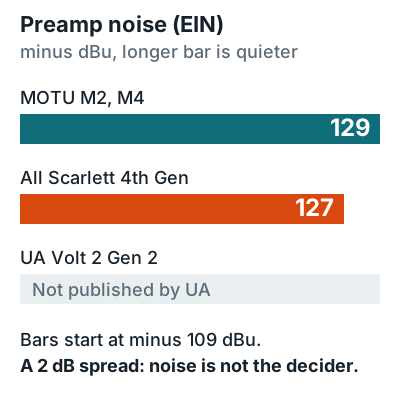
Inputs come first, then gain, then features. Preamp noise barely separates current interfaces, whatever the forum threads say.
- Count simultaneous sources. One mic preamp per mic you record at once.
- Check the gain. Quiet dynamic mics need a lot of it. The Scarlett 2i2, 18i16, and 18i20 have 69 dB, and the Scarlett Solo has 57 dB.
- Check for instrument inputs. Guitar and bass need a 1 megohm Inst or Hi-Z input, and every pick here has at least one.
- Count outputs. Two line outputs run one pair of monitors; the M4's four run two pairs.
- Check power. Bus-powered models run off your laptop. The 18i20 needs a wall outlet.
Sample rate settings are explained in sample rate and bit depth, and setting levels in gain staging. The interface is one line on the home recording equipment list, and the full studio plan is in the home recording studio guide.
Audio interface guides
Every question about choosing, connecting, and using an interface has its own page, so you don't have to dig for the answer here.
FAQ
What is the best audio interface for beginners?
The Focusrite Scarlett 2i2 4th Gen. It has two mic inputs, two instrument inputs, and Auto Gain and Clip Safe, which set and protect your recording levels for you.
What are the top 5 audio interfaces for a home studio?
For one to four mics: Focusrite Scarlett Solo, Scarlett 2i2, MOTU M2, Universal Audio Volt 2 Gen 2, and MOTU M4. Step up to a Scarlett 18i16 or 18i20 when you need 4 or 8 mic preamps.
How many inputs does my audio interface need?
One mic preamp for every mic you record at the same time. A singer-songwriter needs 2, a podcast with two hosts needs 2, and a drum kit needs 4 to 8.
Do I need a USB-C audio interface?
No. The Scarlett and Volt picks use a USB-C connector running the USB 2.0 protocol, and MOTU says the M2 and M4 also work with USB Type-A ports. Bus power matters more: the Scarlett 18i16 draws 3 A over USB.
Does a more expensive interface sound better?
Not much at home. Published preamp noise for the six picks that list it sits between minus 127 and minus 129 dBu, so the extra money buys inputs, outputs, and features, not cleaner sound.