Vocal Booths for Home Studios
A vocal booth is a small enclosure around the singer or the mic that keeps room echo (and, in sealed models, outside noise) out of the recording. Reflection filters and fabric booths fix echo for a few hundred dollars. A sealed booth like WhisperRoom's MDL 4848 S blocks 32 to 46 dB of outside noise, but it lists at $5,995 and weighs 680 lb. Most home singers need the first kind, not the second.
Booth vs treated room vs reflection filter
There are four ways to get a dry vocal at home, and only the sealed booth stops sound coming in from outside. The other three absorb reflections, which Auralex's home studio guide separates from blocking: absorbing improves "sound within a room," and blocking stops "sound transmission."
Reflection filter
Echo only
A curved absorber behind the mic, such as the sE RF-X or Primacoustic VoxGuard.
Fabric booth
Echo only
A frame hung with heavy pads that you stand inside, such as the Snap Studio.
Treated room
Echo only
Absorbing panels on the walls around you. They help your mixes too.
Sealed booth
32 to 59 dB
Rigid walls, a sealed door, and a fan, like a WhisperRoom.
| Option | Blocks outside noise | Covers | Floor space | Price |
|---|---|---|---|---|
| Reflection filter | About 4 dB (Kaotica's figure) | Back and sides of the mic | Mic stand | Under $300 |
| Fabric booth | No rating; "not soundproof" | All around the singer | 33 by 33 in and up | $549.99 to $799.99 (Snap Studio) |
| Treated room | No | The whole room | None extra | Depends on panel count |
| Sealed booth | 32 to 59 dB | All around, sealed | About 4 by 4 ft | $5,995 (WhisperRoom MDL 4848 S) |
The treated room route is in home studio acoustic treatment, and panel positions are in where to place acoustic panels.
How much outside noise a booth blocks
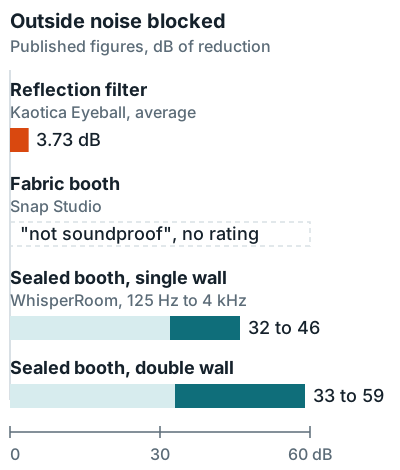
A sealed booth blocks tens of decibels. Everything else blocks a few. WhisperRoom's ASTM E336 field results show 32 to 46 dB for its single-wall booths and 33 to 59 dB for double-wall. Kaotica lists the Eyeball's transmission loss at 3.73 dB average.
Bass: second wall barely helps
32 vs 33 dB
At 125 Hz the double wall adds 1 dB, so traffic rumble and your neighbor's bass get through about the same.
Voice range: second wall pays off
35 vs 46 dB
At 1 kHz the double wall blocks 11 dB more, which keeps household chatter out of your takes.
Snap Studio says its booth "is not soundproof, but it significantly reduces echo and reverb." Even WhisperRoom's FAQ says its booths "are not fully soundproof." If noise is your problem, start with how to soundproof a room before you buy any booth.
Size and floor space
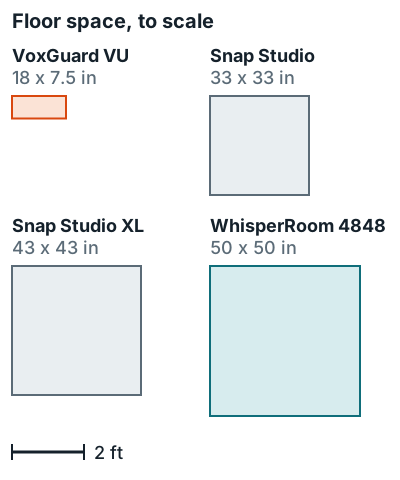
A one-person standing vocal booth needs about 3 to 4 feet square of floor. The figure below draws four real products at the same scale.
| Product | Type | Footprint | Height | Weight |
|---|---|---|---|---|
| Primacoustic VoxGuard VU | Reflection filter | 18 x 7.5 in | 15 in | Not listed |
| Snap Studio | Fabric booth | 33 x 33 in | 6 ft 8 in inside | Not listed |
| Snap Studio XL | Fabric booth | 43 x 43 in | 6 ft 11 in outside | Nearly 40 lb of pads |
| WhisperRoom MDL 4848 S | Sealed booth | 4 ft 2 in square | 6 ft 11 in outside | 680 lb |
Measure your ceiling before you order a sealed booth. WhisperRoom says the ventilation adds about 5.5 inches to the 6 foot 11 inch exterior height. And if you rent, those 680 lb have to come back down the stairs at move-out.
Which one to choose
Pick by the problem you hear in your recordings, not by price.
- Echo or a boxy sound in a quiet house calls for a reflection filter. The sE RF-X uses four layers (vented panel, wool, air gap, foam). It only covers the back and sides of the mic, so hang a heavy blanket or panel behind your head too.
- Echo from every wall in a small or bare room needs a fabric booth or a treated corner. Snap Studio claims up to 80 percent less echo and reverb. Compare models in the best portable vocal booths.
- Neighbors, traffic, or family in your takes means a sealed booth, bought or built. See how to build a vocal booth and the vocal booth build cost.
- Daily voice over or podcast work raises the bar. Spoken word has no music to hide background noise, so isolation matters more. The home voice over studio guide covers that setup.
Booth problems to plan for
A small booth fixes room echo but brings its own issues. Each one has a known fix.
| Problem | Why it happens | Fix |
|---|---|---|
| Boxy, hollow tone | Small space with walls close to the mic | Keep the mic off the walls; add thicker absorption |
| Heat and stale air | A sealed booth has no air exchange | Choose a booth with a ventilation system, as on the WhisperRoom 4848 |
| Slow install | Sealed panels are heavy | WhisperRoom says small models take 2 to 4 hours to assemble |
| Booth sound in the vocal | A sensitive mic picks up the booth itself | Sing closer, or try a dynamic mic |
Mic choice changes how much of the booth you hear. See condenser vs dynamic microphones, then set distance and levels with how to record vocals at home. All soundproofing options are in how to soundproof a home studio.
FAQ
Is a vocal booth soundproof?
Only a sealed, rigid booth blocks much outside noise, and even WhisperRoom says its booths are not fully soundproof. Its double-wall models reduce noise 33 to 59 dB. Fabric booths and reflection filters control echo but block very little.
How big is a home vocal booth?
A one-person standing booth takes about 3 to 4 feet square. Snap Studio's fabric booth needs 33 by 33 inches, and WhisperRoom's MDL 4848 S is 4 feet 2 inches square outside with a 3 foot 10 inch interior.
Do I need a vocal booth to record vocals at home?
No. A reflection filter or a few absorbing panels around the singer fix echo in most quiet homes. You need a sealed booth only when outside noise shows up in your takes.
What is the difference between a vocal booth and an iso booth?
Nothing. Iso booth is short for isolation booth, the same small enclosed space. The name promises isolation, but only sealed models deliver it.
What makes a vocal booth professional?
Isolation you can measure. WhisperRoom publishes field test results to ASTM E336 for its booths. Fabric booths and filters publish echo claims or no rating at all.