How Can I Soundproof My Home Studio?
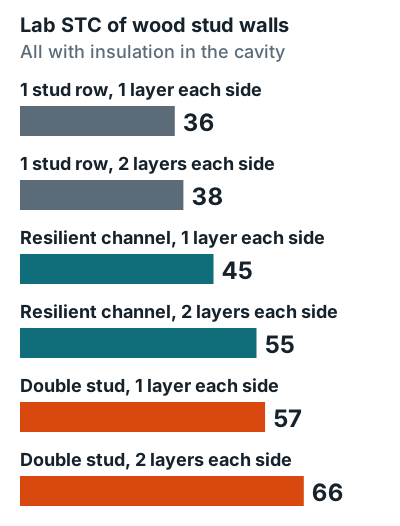
You soundproof a home studio by sealing every air gap, then decoupling the walls from each other, then adding mass, in that order. In lab tests, a normal insulated wood stud wall rates STC 36, while two separate stud walls with two layers of drywall per side reach STC 66, according to Table 9.10.3.1.-A of the BC Building Code.
Most of that is construction work. If you rent, the renters section below is the honest version of what you can do.
Soundproofing is not acoustic treatment
Soundproofing stops sound passing between rooms. Acoustic treatment only changes how the room sounds inside it. Auralex's home studio guide splits its products the same way: "Absorb Sound to improve sound within a room or Block Sound to stop sound transmission."
Soundproofing
Blocks
Seals, mass, and decoupled walls, doors, and floors. Keeps your music in and the traffic out.
Foam on the walls won't stop your neighbor from hearing you.
More on that in do acoustic panels keep sound out and acoustic foam.
Why soundproofing a room for music is harder than for speech
Music is louder and bassier than the speech that wall ratings are built around. The STC standard, ASTM E413, says the rating "is not appropriate" for sources whose spectra differ from speech, and it lists "musical instruments" among them.
STC is calculated from 125 Hz up, using "a minimum frequency range of 125 to 4,000 Hz" per USG's STC method. So the lowest notes of a kick drum or bass guitar don't count toward the number at all, and those are the notes that travel.
Seal, decouple, then add mass
Sound leaves a room three ways: through air gaps, through the wall surfaces, and through the studs and floor that tie one side to the other. Each path has its own fix.
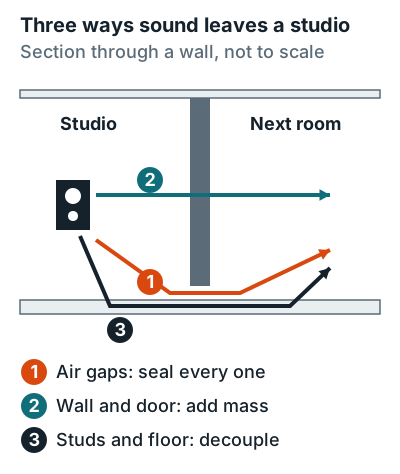
- Seal. In a Hilti lab test, sealing the perimeter gaps of a chase wall took it from STC 34 to STC 63. That's a 29-point jump from sealant alone. Zero International puts it plainly on its door seal page: "sound travels through any opening with very little loss."
- Decouple. Resilient channel on one side lifts an insulated single stud wall from STC 36 to 45. Two separate stud rows reach 57, per the BC Building Code table.
- Fill the cavity. Owens Corning's wall assembly guide says insulation "can increase sound transmission loss by about 8dB" in walls with isolated faces. A double stud wall with empty cavities rates STC 45, against 57 with both insulated.
- Add mass. USG's acoustical assemblies guide says doubling a partition's mass cuts sound transmission "by up to 5 dB." Add drywall layers after decoupling, where they count for more.
How much isolation a music room needs
Match the build to the loudest thing you play and who's on the other side of the wall. Riverbank Acoustical Laboratories' STC guide gives the meaning column below. Keep in mind that music leaks more than these speech-based ratings suggest.
| Lab STC | What Riverbank says you hear | Build that gets there | Fits |
|---|---|---|---|
| 35 to 45 | "Loud speech is audible but less intelligible" | Normal wall, sealed; resilient channel | Vocals, voice-over, acoustic guitar at modest level |
| 50 to 55 | "Loud sounds are still audible through the wall" | Resilient channel, 2 layers each side | Monitors and amps at moderate volume |
| 60 to 65 | "Loud sounds are barely audible" | Double stud, 2 layers each side | Drums, bass amps, late sessions |
If you only track vocals, a sealed booth is often a smaller job than rebuilding walls. WhisperRoom rates its booths at 32 to 46 dB (standard) and 33 to 59 dB (enhanced) under ASTM E336. Compare options in vocal booths for home studios.
What renters can actually do
Renters can close air gaps and add removable mass. Decoupling walls is off the table. Each of these comes back out when you leave:
- Seal the door. Fit a perimeter gasket and a sweep or door bottom so the gaps around the door stop leaking.
- Swap a hollow door. Masonite says the "added density" of solid core doors helps "reduce the transfer of noise between rooms." Store the original, rehang it at move-out, and ask your landlord before you start.
- Plug the window. A removable insert seals the glass and adds mass over it. See soundproofing a room from outside noise.
- Shrink the loud source. Record vocals in a portable vocal booth, switch to an electronic drum kit, and mix on headphones late at night.
The full renter's version, including shared walls and floors, is in how to soundproof a room in an apartment.
Build order for a home studio
Work from the cheapest fix to the most expensive, and stop when the room is quiet enough.
- Seal gaps at outlets, wall edges, and pipes with acoustical sealant. The ranked list is in how to soundproof a room cheaply.
- Fix the door, then the window. Step-by-step methods for doors, windows, walls, and floors are in how to soundproof a room.
- Upgrade the shared wall with resilient channel or clips, insulation, and a second layer of drywall.
- Build a room within a room if you play drums or loud amps. See room within a room soundproofing and the soundproof drum room guide.
- Treat the inside last, because a sealed room gets boomy. Start with the acoustic treatment guide.
Budget for each step with how much it costs to soundproof a room.
Every soundproofing and vocal booth guide
Every page in this section, grouped by the job. For gear, budget, and layout, start with the home recording studio guide.
Your situation
Big builds
Vocal booths
Vocal booths, best portable vocal booths, build a vocal booth, booth build cost.
FAQ
Can you completely soundproof a music room?
Not in a house. The best wood stud wall in the BC Building Code tables (double studs, two layers of drywall each side) rates STC 66, and Riverbank Acoustical Laboratories describes STC 60 to 65 as loud sounds barely audible, not silent. Bass gets through more than the rating suggests.
Does acoustic foam soundproof a room?
No. Foam and panels absorb sound inside the room. They don't stop it passing through walls. Auralex itself separates absorbing sound from blocking sound.
What is the best wall for a music room?
Two separate rows of studs with insulation in both and two layers of drywall on each side. That build rates up to STC 66 in the BC Building Code tables, against 36 for a normal insulated wall.
Should I soundproof the room or buy a vocal booth?
If you only record vocals, a sealed booth is a smaller job. WhisperRoom rates its standard booths at 32 to 46 dB of noise reduction and its enhanced double wall models at 33 to 59 dB.
How much does it cost to soundproof a music room?
Sealing gaps and fitting door seals costs little. A room within a room is a full construction project. The numbers are in the guide to soundproofing costs.
More answers: Home recording FAQ