Best Studio Headphones
The best studio headphones for a home studio are a closed-back pair for tracking, like the Sennheiser HD 280 PRO with up to 32 dB of noise attenuation, and an open-back pair for mixing, like the 9.2 oz (260 g) Sennheiser HD 600. If you're only buying one pair, make it the Beyerdynamic DT 770 PRO 80 ohm or the DT 700 PRO X. Both handle both jobs.
Quick picks
Six professional studio headphones cover tracking, mixing, and long sessions.
| Pick | Job | Key spec | Price band |
|---|---|---|---|
| Sennheiser HD 280 PRO | Tracking on a budget | Up to 32 dB attenuation | Under $150 |
| Beyerdynamic DT 770 PRO 80 ohm | Tracking, all-round | 3.5 to 5.5 N clamping | $150 to $250 |
| Beyerdynamic DT 700 PRO X | One pair for everything | 48 ohms, closed | $250 to $350 |
| Sony MDR-M1 | Long sessions, closed | 216 g | $250 to $350 |
| Sennheiser HD 600 | Mixing | 300 ohms, open | $300 to $450 |
| Beyerdynamic DT 900 PRO X | Mixing on any interface | 48 ohms, open | $250 to $350 |
Tracking vs mixing headphones
Wear closed-back cans whenever a mic is open, and save open-backs for mixing. Beyerdynamic's own DT 990 PRO page warns that open-back models can bleed into sensitive microphones, and notes that open designs are often used for mixing because of their better spatial representation.
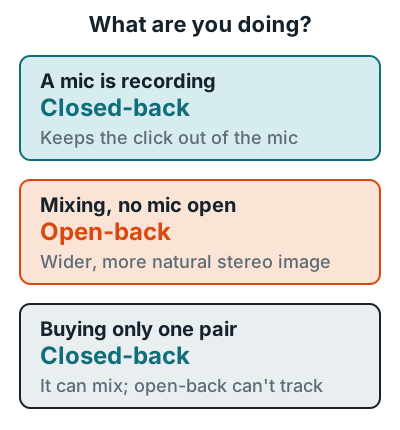
Open-backs leak. Turn the click up loud enough and the mic will pick it up, so track vocals on closed-backs. The full tradeoff, with a comparison table, is on closed-back vs open-back headphones.
The 6 best studio headphones
Every pick is current on its maker's site, and the specs come from the manufacturer's own page.
Sennheiser HD 280 PRO
For tracking vocals and drums when the budget is tight.
- Up to 32 dB of ambient noise attenuation, per Sennheiser's HD 280 PRO page
- 64 ohms impedance
- 10.1 oz (285 g) without cable
- Coiled, single-sided cable from 4.3 to 9.8 ft (1.3 to 3 m); folds flat, with replaceable pads
The catch: Sennheiser doesn't list a sensitivity figure, so you can't compare its loudness against the other picks on paper.
Price band: under $150.
Beyerdynamic DT 770 PRO (80 ohm)
For tracking and everyday monitoring, with velour pads.
- Comes in 32, 80, or 250 ohms; Beyerdynamic labels 80 ohms "Universal Studio," per its DT 770 PRO page
- 5 Hz to 35 kHz frequency response
- About 13.2 oz (375 g) with cable
- 3.5 to 5.5 N of clamping force, and gray velour pads on the 80 and 250 ohm versions
At about 13.2 oz (375 g) with cable, it's the heaviest pair here.
Price band: $150 to $250.
Beyerdynamic DT 700 PRO X
For a home studio that buys one pair to track and mix on.
- Sold for "recording, monitoring and mixing," per Beyerdynamic's DT 700 PRO X page
- 48 ohms, with 100 dB SPL sensitivity
- 12.3 oz (350 g) without cable
- Detachable mini XLR cable, 5.9 or 9.8 ft (1.8 or 3 m); replaceable velour pads and headband
Price band: $250 to $350.
Sony MDR-M1
For long sessions on a closed pair.
- About 7.6 oz (216 g) without cable, the lightest closed pair here, per Sony's MDR-M1 spec sheet
- 50 ohms, with 102 dB/mW sensitivity
- 5 Hz to 80 kHz frequency response
- 3.9 ft (1.2 m) and 8.2 ft (2.5 m) cables with a stereo mini plug, plus a quarter-inch adapter
Price band: $250 to $350.
Sennheiser HD 600
For mixing, once a closed pair is handling your tracking.
- Open-back dynamic, per Sennheiser's HD 600 page
- 300 ohms, with 97 dB SPL at 1 V
- 9.2 oz (260 g)
- Detachable 9.8 ft (3 m) cable, quarter-inch plug with a 3.5 mm adapter
The catch: 300 ohms needs a strong headphone output. Check your interface's headphone amp before you buy, or you'll be running the knob near the top.
Price band: $300 to $450.
Beyerdynamic DT 900 PRO X
For open-back mixing straight from an interface or laptop.
- Built for "critical listening, mixing and mastering," per Beyerdynamic's DT 900 PRO X page
- 48 ohms; Beyerdynamic says it runs on an interface, laptop, tablet, or phone
- 12.2 oz (345 g) without cable
- Detachable mini XLR cable, 5.9 or 9.8 ft (1.8 or 3 m)
Price band: $250 to $350.
Comfort over a 3-hour session
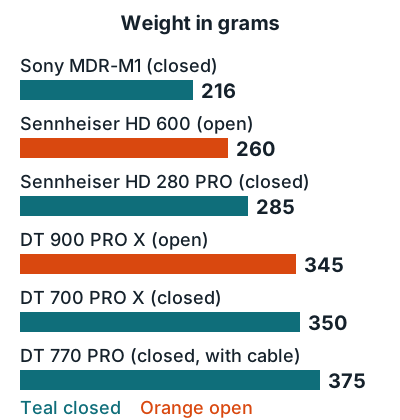
Weight, clamping force, and pad material decide how a pair feels in hour three. Across these picks, weight runs from 7.6 oz (216 g, Sony MDR-M1) to about 13.2 oz (375 g with cable, DT 770 PRO).
Weight
Under 10.6 oz (300 g)
The MDR-M1, HD 600, and HD 280 PRO all come in under that.
Pads
Replaceable
Velour breathes better than leatherette, and every Beyerdynamic pick here has replaceable velour pads.
Volume
85 dBA
NIOSH's limit for 8 hours. Every 3 dBA louder halves the safe time.
The NIOSH noise exposure limit is 85 dBA averaged over 8 hours, with a 3 dBA exchange rate, so a 3-hour session at 88 dBA already eats most of a 4-hour daily allowance. Turn it down a notch.
How to choose studio headphones
Pick the back type first, then check impedance and weight.
- Decide what the pair is for. Tracking needs closed-back, and mixing is better on open-back. One pair for both means closed-back. See the best closed-back studio headphones or best open-back studio headphones for more picks.
- Match impedance to your output. 32 to 80 ohms suits an interface or laptop. 250 to 300 ohms needs a strong headphone amp.
- Check weight and pads. Under 10.6 oz (300 g) and replaceable velour pads make long sessions easier.
- Get a detachable cable if you can. The DT 700 PRO X, DT 900 PRO X, HD 600, and MDR-M1 all take a replacement cable.
Headphones won't replace monitors for checking a mix, so pair them with the best studio monitors for home studios. For setting up a headphone mix while you sing, see how to monitor vocals while recording.
FAQ
Can I use one pair of studio headphones for tracking and mixing?
Yes, as long as it's closed-back, because open-back headphones leak into the vocal mic. The Beyerdynamic DT 700 PRO X is sold for recording, monitoring, and mixing, so it suits a one-pair studio.
What impedance should studio headphones be?
For an audio interface or laptop, 32 to 80 ohms is the safe range. Beyerdynamic labels its 80 ohm DT 770 PRO for universal studio use and the 250 ohm version for professional devices.
Are studio monitor headphones the same as studio headphones?
Yes. Makers use both names for headphones voiced for accurate monitoring rather than boosted bass, such as the Sony MDR-M1, which Sony calls a reference closed monitor headphone.
How long can I wear studio headphones safely?
NIOSH sets 85 dBA over 8 hours as its exposure limit and halves the time for every 3 dBA increase. At 94 dBA, that's 1 hour a day.
Do I need a headphone amp for studio headphones?
Not for low-impedance models like the 48 ohm DT 700 PRO X, which Beyerdynamic says runs from an interface, laptop, or phone. High-impedance models like the 300 ohm HD 600 benefit from a strong headphone output.