Best Audio Interface for Guitar Recording
The best audio interface for guitar recording for most players is the Focusrite Scarlett 2i2 4th Gen: two 1 megohm instrument inputs, so you can record guitar and a vocal mic together, plus bundled Softube amp sims. For the lowest published latency, pick the MOTU M2. If you care how the input loads your pickups, or you want to reamp, pick the IK Multimedia AXE I/O Solo.
One thing to know up front: the lag you feel through an amp sim comes mostly from your buffer setting, not the logo on the box.
Quick picks
Every pick has a guitar input that works without an amp or DI box, and every spec comes from the maker's product page.
| Pick | Best for | Guitar input | Price band |
|---|---|---|---|
| Focusrite Scarlett 2i2 4th Gen | Guitar plus vocals, most players | 2 x 1 megohm | $200 to $250 |
| Focusrite Scarlett Solo 4th Gen | Guitar and one mic on a budget | 1 x 1 megohm | $150 to $200 |
| MOTU M2 | Lowest published latency | 2 Hi-Z combo inputs | $150 to $250 |
| Universal Audio Volt 2 Gen 2 | UAD amp and bass plugins | 2 x 1 megohm | $250 to $300 |
| IK Multimedia AXE I/O Solo | Tone shaping, reamping | 2.2 kilohm to 1 megohm | $150 to $250 |
If you need more mic inputs for drums or a band, the best audio interface for home recording hub covers 4 and 8 preamp models. On a tighter budget, see the best audio interface under $150.
The 5 best audio interfaces for guitar
The first four picks match the hub's recommendations. The AXE I/O Solo is here because it's built around guitar.
Focusrite Scarlett 2i2 4th Gen
For guitarists who also sing, or who track two guitar parts, or a DI and an amp mic, at once.
- 2 inputs switchable to instrument at 1 megohm, with a 12 dBu maximum input, per Focusrite's Scarlett 2i2 page
- 69 dB of mic gain on both inputs, the most of these picks
- A Softube collection of amp sims, which Focusrite lists in its bundled Hitmaker Expansion
- Direct monitoring, so you hear the dry guitar with no latency while you record
The catch: direct monitoring is dry. You hear the clean DI, not the amp sim, so to play through the sim you monitor through the DAW at a small buffer.
Price band: $200 to $250.
Focusrite Scarlett Solo 4th Gen
For recording guitar and one vocal mic on the smallest budget.
- 1 dedicated instrument input at 1 megohm and 1 mic preamp with 57 dB of gain, per Focusrite's Scarlett Solo page
- 4 x 2 simultaneous I/O including loopback, so the guitar and mic inputs record at once
- Minus 127 dBu EIN on the mic input
- Comes with Hitmaker Expansion, Pro Tools Intro+, Ableton Live Lite, and Cubase LE
It has one instrument input, so no stereo guitar rigs and no DI plus a second guitar.
Price band: $150 to $200.
MOTU M2
For players who monitor through amp sims and want the lowest published round-trip latency here.
- 2.5 ms round trip latency at 96 kHz with a 32-sample buffer, per MOTU's M2 page
- 2 combo inputs for mic, line, or Hi-Z guitar, each with its own gain knob
- Minus 129 dBu EIN on the mic inputs, the lowest of these picks
- Full-color LCD meters on every input, so you can watch guitar peaks without staring at the DAW
MOTU doesn't publish the Hi-Z input's impedance, and it bundles no named amp sims, just Performer Lite (with guitar effects) and Ableton Live Lite.
Price band: $150 to $250.
Universal Audio Volt 2 Gen 2
For guitarists who want UAD amp plugins and a bass amp bundle out of the box.
- 2 front Hi-Z inputs at 1 megohm with 60 dB of gain, per UA's Volt 2 Gen 2 page
- UA's included software list names the UAD Showtime '64 Tube Amp and Lion '68 Super Lead Amp, plus Plugin Alliance's Ampeg SVT-VR Classic bass bundle
- Tone Shaping, with three preamp modes (Warmth, Focus, and Shine), Warmth inspired by the UA 610 tube preamp
- Auto-Gain to set the input level for you, with Clip Protection for sudden peaks
The catch: no MIDI ports, and its 60 dB of mic gain is 9 dB less than the Scarlett 2i2's 69 dB. That matters if you mic a cab at bedroom volume with a quiet dynamic mic.
Price band: $250 to $300, listed at $274 at the time of writing.
IK Multimedia AXE I/O Solo
For players who care how the input loads their pickups, and who want to reamp through a real amp.
- Z-Tone, which varies the passive instrument input impedance from 1 megohm down to 2.2 kilohm, per IK's AXE I/O Solo specs; active mode is fixed at 10 kilohm
- A choice of PURE mode, transparent at 0.002 percent THD, or JFET mode at 0.5 percent
- A dedicated reamp output with ground lift, so you can send a recorded DI back through your amp
- AmpliTube 5 SE and TONEX SE in the box
It has one XLR mic input and a USB-B port, so it's a weaker fit for vocal-heavy work than the Scarlett 2i2.
Price band: $150 to $250.
What a Hi-Z input does
A Hi-Z (instrument) input matches a guitar's high-impedance pickups, so you plug in with a normal guitar cable and skip the DI box. Focusrite, UA, and IK all specify 1 megohm for their instrument inputs, and IK's Z-Tone lets you go lower.
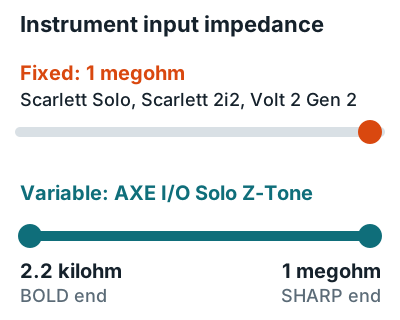
On a Scarlett 2i2, the same 1/4 inch jack is 60 kilohm with Inst off and 1 megohm with it on. With Inst off, the 60 kilohm load can dull the tone, so always press it for guitar. Cables, settings, and gain are covered step by step in how to connect a guitar to an audio interface.
Amp sim latency
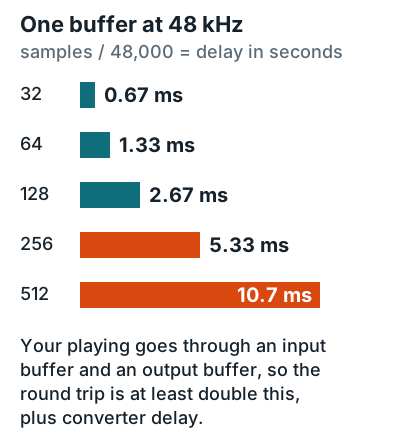
Amp sim latency comes mostly from your DAW's buffer size, not the interface brand. Each buffer has to fill before it's processed, so the delay is the buffer length divided by the sample rate.
How to choose an audio interface for guitar
Choose by how many things you record at once, then by the software and extras you'll actually use.
- Count sources. Guitar only needs one instrument input. Guitar and vocal together need an instrument input plus a mic preamp, as on the Solo or 2i2; see recording guitar and vocals at the same time.
- Check the Hi-Z spec. Look for an Inst or Hi-Z input at 1 megohm, or a variable one like the AXE I/O Solo's.
- Decide on amp sims. The bundles (Softube on the Scarlett, UAD on the Volt 2 Gen 2, AmpliTube and TONEX on the AXE I/O Solo) save you buying plugins at first.
- Check monitoring. Direct monitoring is dry. To hear the amp sim while you play, you need a small buffer and a fast driver.
- Plan for a mic. To mic an amp or an acoustic, you need gain: 69 dB on the Scarlett 2i2, 60 dB on the Volt 2 Gen 2. Mic choice is covered in how to record acoustic guitar.
Once you're plugged in, recording guitar on a computer walks through the whole workflow, and FL Studio users can follow how to record guitar in FL Studio.
FAQ
Do I need a special audio interface for guitar?
No. Any interface with an instrument (Inst or Hi-Z) input records guitar directly. Focusrite, UA, and IK publish 1 megohm for theirs; MOTU's M2 has Hi-Z inputs but doesn't publish the figure.
Can I plug a guitar into the line input?
Use the Inst setting instead. On a Scarlett 2i2 4th Gen, Inst raises the 1/4 inch input from 60 kilohm to 1 megohm, the impedance it specifies for instruments.
What buffer size should I use for amp sims?
64 or 128 samples at 48 kHz, which is 1.3 or 2.7 ms per buffer. Your playing passes an input and an output buffer, so the delay you feel is at least double that.
Do I need an amp to record guitar?
No. Plug straight into the Inst input and use amp plugins: the Scarlett bundles Softube amp sims, the Volt 2 Gen 2 lists two UAD amps, and the AXE I/O Solo comes with AmpliTube 5 SE and TONEX SE.
Can I record bass with the same interface?
Yes. Bass uses the same instrument input, and UA lists the Ampeg SVT-VR Classic bass bundle in the Volt 2 Gen 2's included software.