Best Microphone for Recording Acoustic Guitar
The best mic for recording acoustic guitar is a RØDE NT5 matched pair: two small diaphragm condensers that record one mic in mono or both in mono-safe XY stereo. If you only want one mic, the Shure SM81 adds a pad and low-cut switch. If you sing too, the RØDE NT1 5th Gen handles both jobs at 4 dBA self-noise.
The real decision is a small diaphragm pair vs a single large diaphragm. That comes down to the tone you're after and whether you'll ever want stereo. If you write songs on guitar and sing them, read the NT1 section before you buy anything.
Quick picks
Here are five current condensers, with specs taken from each maker's own page or spec sheet.
| Pick | Type | Best for | Key spec | Price band |
|---|---|---|---|---|
| RØDE NT5 matched pair | Small diaphragm pair | Best overall, mono or XY stereo | 143 dB SPL max | $300 to $500 a pair |
| Neumann KM 184 stereo set | Small diaphragm pair | A pair to keep for decades | 13 dB-A self-noise | Over $1,500 a pair |
| Shure SM81 | Small diaphragm | Best single mic | 10 dB pad, 3-step low cut | $300 to $500 |
| RØDE NT1 5th Gen | Large diaphragm | Guitar and vocals, one mic | 4 dBA self-noise | $200 to $400 |
| Audio-Technica AT2020 | Cardioid condenser | Budget | 20 dB SPL self-noise | $100 to $200 |
Small diaphragm pair vs single large diaphragm
Pick a small diaphragm condenser (SDC) for accuracy and a large diaphragm condenser (LDC) for warmth. Lewitt's acoustic guitar guide says small diaphragms are known for "fast transient response and accurate frequency balance," while large diaphragms "capture more fullness and warmth."
SDC pair
Mono or stereo
Detailed, true-to-the-guitar tone. Buy a matched pair and you can record XY stereo, or overheads on drums. Needs 2 inputs for stereo.
Single LDC
Mono only
Fuller, warmer tone that sits well on solo guitar and also records vocals. One input, one mic to buy.
A pair only earns its keep in stereo, and XY is the stereo setup that stays safe in mono. DPA's stereo guide says there are "no comb filtering effects summing XY signals to mono," while a spaced pair "is generally not suitable for mono." Condenser and dynamic types are compared on condenser vs dynamic microphone.
Where each pick goes
Every pick starts in one of two spots: a single mic 10 to 12 inches from the 12th fret, or an XY pair at 90 degrees from the same distance. The 12th fret spot and the 90 degree XY angle come from Lewitt's guide. It also says to keep the mic off the sound hole, because that's where the strong low-frequency resonance lives. Aim at the sound hole and you get boom, not guitar.
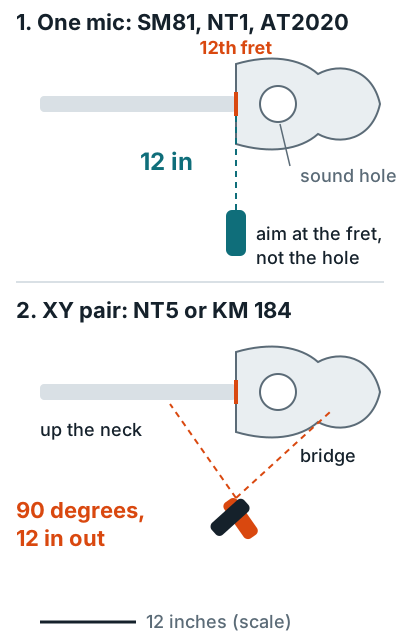
Spaced pairs, distances by strumming style, and a mono check are on how to record acoustic guitar. Spacing for a spaced pair follows the 3:1 rule.
RØDE NT5 matched pair: best overall
The RØDE NT5 is the best value acoustic guitar mic, because RØDE sells it as a certified matched pair for stereo. Acoustic instruments, drum overheads, and cymbals are among its listed uses, so the pair keeps earning its place long after the guitar track is done.
| Spec | NT5 |
|---|---|
| Capsule, pattern | 1/2 inch, cardioid condenser |
| Frequency range | 20 Hz to 20 kHz |
| Self-noise | 16 dBA |
| Max SPL | 143 dB SPL |
| Sensitivity | minus 38 dBV (12 mV) |
| Power | 48 V phantom |
Specs are from the NT5 datasheet, which lists two mic clips and two windshields in the pair kit.
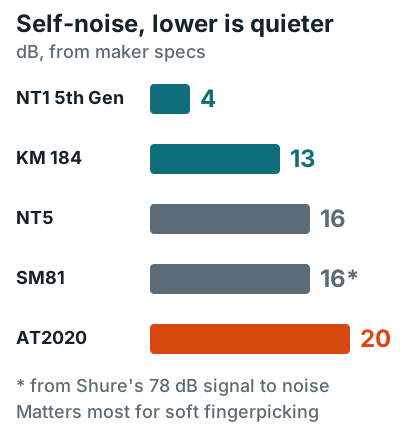
The catch: 16 dBA is 12 dB noisier than the NT1. You may hear that hiss on very quiet fingerpicking with the gain cranked.
Neumann KM 184: the premium pair
The Neumann KM 184 is the pair to buy if you never want to shop for SDCs again. Neumann lists acoustic guitar among its applications and sells it as a stereo set with two windscreens and two stand mounts.
| Spec | KM 184 |
|---|---|
| Pattern | Cardioid condenser |
| Frequency range | 20 Hz to 20 kHz |
| Sensitivity | 15 mV/Pa |
| Self-noise | 13 dB-A |
| Max SPL | 138 dB (0.5% THD) |
| Power | 48 V phantom, 3.2 mA |
The stereo set costs several times the NT5 pair, and on paper what you gain is 3 dB less self-noise. If your room is untreated, spend that money on treatment first.
Shure SM81: best single mic
The Shure SM81 is the single SDC to buy, and Shure names guitar first among the acoustic instruments it's built for. Its switches fix the two common acoustic guitar problems: a 10 dB pad for hard strumming, and a low cut for boom.
| Spec | SM81 |
|---|---|
| Pattern | Cardioid condenser |
| Frequency response | 20 Hz to 20 kHz |
| Sensitivity | minus 45 dBV/Pa (5.6 mV) |
| Max SPL | 136 dB SPL |
| Low cut | Flat, 18 dB/octave below 80 Hz, or 6 dB/octave below 100 Hz |
| Power | 11 to 52 V phantom |
Specs are from the SM81 user guide, which also notes a 6 to 10 dB bass rise below 100 Hz at 1/4 inch from the source.
One mic means mono only. You can buy a second SM81 later for a pair, though it won't be factory-matched.
RØDE NT1 5th Gen: one mic for guitar and vocals
The RØDE NT1 5th Gen is the pick if one mic has to cover both your guitar and your voice. It's the quietest mic here at 4 dBA, with XLR and USB-C outputs, per its datasheet.
At 25 mV/Pa it hears your room clearly, so give it a treated space. It's also the treated-room pick on best microphone for recording vocals.
Audio-Technica AT2020: budget pick
The Audio-Technica AT2020 is the cheapest condenser worth putting in front of an acoustic, at a listed $119. It's a cardioid condenser with a 20 Hz to 20 kHz response, 144 dB SPL max, and 48 V phantom power.
The catch: 20 dB SPL self-noise is the highest here, and there's no pad or low cut.
How to choose an acoustic guitar mic
Answer four questions and the five picks narrow to one.
- Mono or stereo? Mono only: SM81, NT1, or AT2020. Stereo now or later: NT5 or KM 184 pair, and an interface with two inputs.
- Strummed or fingerpicked? Strumming in a band mix suits an SDC. Soft fingerpicking needs low self-noise, so compare the chart below.
- Do you sing too? One LDC like the NT1 records both. You can even track guitar and voice in one take. See recording guitar and vocals at the same time.
- Is the room treated? Every pick is a condenser, so your room ends up in the recording. The acoustic treatment guide shows what to fix first.
Electric guitar is a different job. Plug in direct with how to connect a guitar to an audio interface or mic the amp with an SM57, covered in the microphones for home recording hub.
FAQ
What is the best mic for recording acoustic guitar?
A RØDE NT5 matched pair for most home studios: one mic for mono parts, both in XY for stereo. For one mic only, the Shure SM81; if you also sing, the RØDE NT1 5th Gen.
Is a small or large diaphragm condenser better for acoustic guitar?
Small diaphragm for an accurate, detailed tone with fast transients; large diaphragm for a fuller, warmer sound, per Lewitt's acoustic guitar guide. Strummed parts in a busy mix usually suit a small diaphragm.
Can I record acoustic guitar with an SM57?
Yes, but its 40 Hz to 15 kHz range misses the top-end sparkle a condenser catches. Use it for rough takes or loud strumming, and switch to a condenser for featured parts.
Do I need two mics to record acoustic guitar?
No. One mic at the 12th fret is the safest choice in a full mix. Two matched mics in XY add stereo width and still sum to mono without comb filtering, per DPA.
Do acoustic guitar mics need phantom power?
Yes. Every condenser here needs it: the NT5, NT1, AT2020, and KM 184 run on 48 V, and the SM81 on 11 to 52 V.