Condenser vs Dynamic Microphone
Buy a dynamic microphone if your room is untreated or your source is loud, and a condenser if your room is treated and you want detail. A condenser is roughly 19 dB more sensitive than a dynamic (the AT2020 puts out 14.1 mV/Pa, the SM58 1.6 mV/Pa), so it hears more of your voice and more of your room.
Condenser vs dynamic compared
A dynamic gives up some detail to be tough and reject more of the room. A condenser gives up toughness to catch detail.
| Dynamic | Condenser | |
|---|---|---|
| How it works | Coil moves in a magnet | Diaphragm moves against a charged backplate |
| Power | None | Battery or phantom power, usually 48 V |
| Example output | SM58: 1.6 mV/Pa | AT2020: 14.1 mV/Pa |
| Room pickup | Less, worked close | More, captures reflections |
| Loud sources | "Almost impossible to overload" (Shure) | Can distort or clip on very loud sources |
| Detail and highs | Narrower response | Wider, smoother response |
| Durability | Rugged, shrugs off heat and humidity | Can turn noisy in extreme heat or humidity |
| Best home use | Untreated rooms, amps, drums, podcasts | Treated rooms, vocals, acoustic guitar, overheads |
Output figures are from the SM58 user guide and Audio-Technica's AT2020 page. The durability and overload notes come from Shure's dynamic vs condenser explainer, and the loud-source and room pickup notes from Universal Audio.
How each type works
A dynamic mic is a tiny generator. Sound moves a diaphragm attached to a coil inside a magnetic field, and that makes a voltage with no power needed. Audio-Technica calls it "a speaker in reverse."
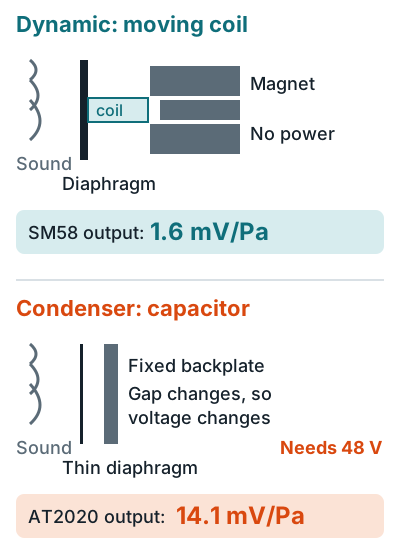
A condenser's thin diaphragm and fixed backplate form a capacitor, and sound changes the gap between them. Shure's transducer basics say the element has "much less mass," so it responds more easily to subtle sounds and high frequencies.
Which to buy for an untreated room
Buy a dynamic for an untreated room. Shure's vocal recording guide says a condenser "will capture room reflections in addition to the direct vocal sound," and that in a room that isn't professionally designed, "those reflections are unlikely to improve the recording."
Shure adds that upgrading gear alone won't fix a reflective room. So a condenser only pays off once the room is under control. What to fix first is in the acoustic treatment guide, and the full case for dynamics on vocals is in are dynamic microphones good for vocals.
Gain and power
A dynamic needs more preamp gain, and a condenser needs phantom power. Shure says to use an inline booster or stronger preamp with the SM7B "if your preamp does not have more than 60 dB of gain."
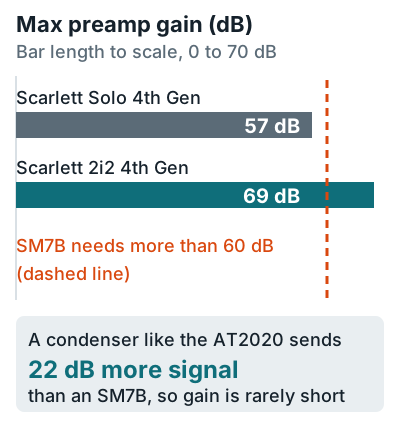
Condenser needs power
48 V
The AT2020 draws 48 V DC phantom power at 2 mA. Most interfaces supply it with one switch.
If your interface comes up short on gain, see do I need a preamp to record vocals. What that 48 V switch actually does is in what does 48V do on an audio interface.
Which type for each source
Universal Audio lists dynamics for loud sources and condensers for detailed, quieter ones. Here's how that maps to a home studio where you sing and play:
| Source | Type | Why | Picks |
|---|---|---|---|
| Vocals, untreated room | Dynamic | Rejects the room | Best microphone for recording vocals |
| Vocals, treated room | Large-diaphragm condenser | More air and detail | Best budget vocal mics |
| Guitar amps, kick, snare, toms | Dynamic | Handles high SPL | Best drum mics |
| Acoustic guitar, overheads | Condenser | Captures transients and highs | Best acoustic guitar mic |
| Podcast, voice over | Dynamic | Room rejection, handling noise | Best voice and podcast mic |
USB or XLR is a separate decision, covered in XLR vs USB microphone. Every pick by source is in the microphones for home recording hub.
FAQ
Is a condenser or dynamic mic better for a bedroom studio?
A dynamic, unless the room is treated. Worked 1 to 6 inches from your mouth, it records your voice and very little of the bare walls.
Do dynamic mics need phantom power?
No. A dynamic generates its own signal from a coil moving in a magnet. Condensers need power, usually 48 V phantom power from the interface.
Can phantom power damage a dynamic mic?
Almost never. Shure says modern dynamics like the SM58 are designed to accept phantom power without issues, but check the manual first if you own a ribbon mic.
Why does my dynamic mic sound so quiet?
Dynamics put out much less signal. The SM7B gives 1.12 mV/Pa against the AT2020's 14.1 mV/Pa, so it needs a preamp with more than 60 dB of gain, per Shure.
Which is more durable?
The dynamic. Shure says it's almost impossible to overload one and that heat and humidity barely affect it, while condensers can turn noisy in extreme temperature or humidity.